← All AP® study guides
AP® Study Guide Printable PDF · 54 pages

TransferCredit.org Guide to AP® European History

AP® European History study guide: a printable PDF built from the College Board's official course and exam description, in the official order.

  • 225 key terms, each with an example
  • 45 practice questions with every answer explained
  • A 2-page cram sheet for the night before
  • 2-, 4- and 8-week study plans built from the exam weights
Not sure yet? Try 10 free questions

Last updated 2026 · exam details checked against the College Board's published exam information in 2026

Look inside the guide

Real pages from the 54-page PDF.

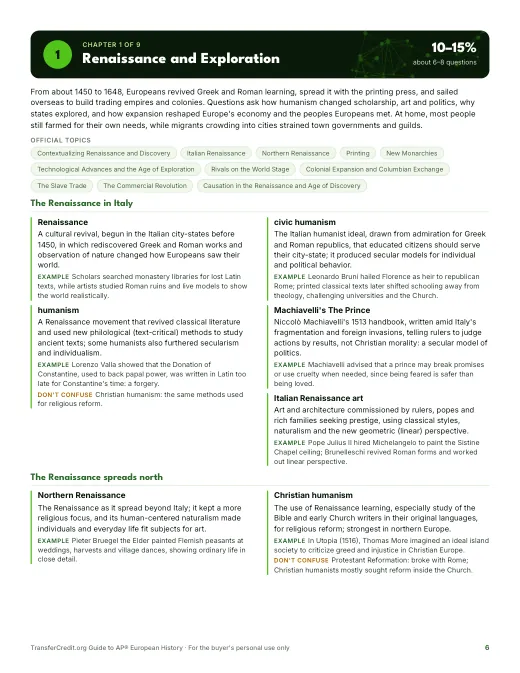
Page 1 of the TransferCredit.org Guide to AP® European History: the cover
Page 1 The cover
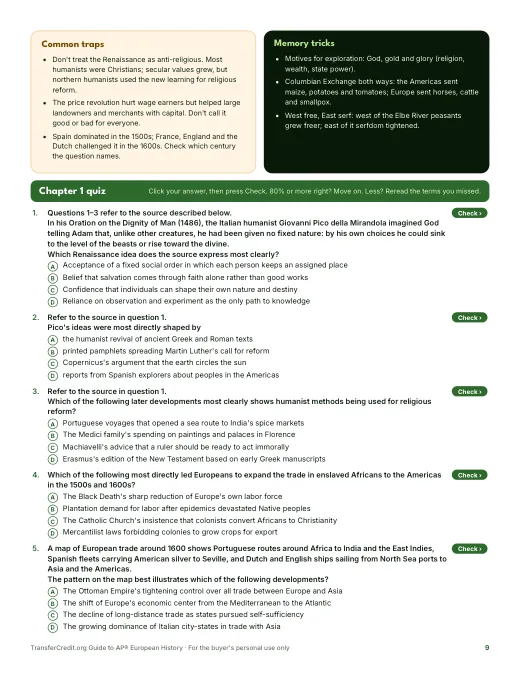
Page 6 of the TransferCredit.org Guide to AP® European History: the Chapter 1 opener
Page 6 The Chapter 1 opener
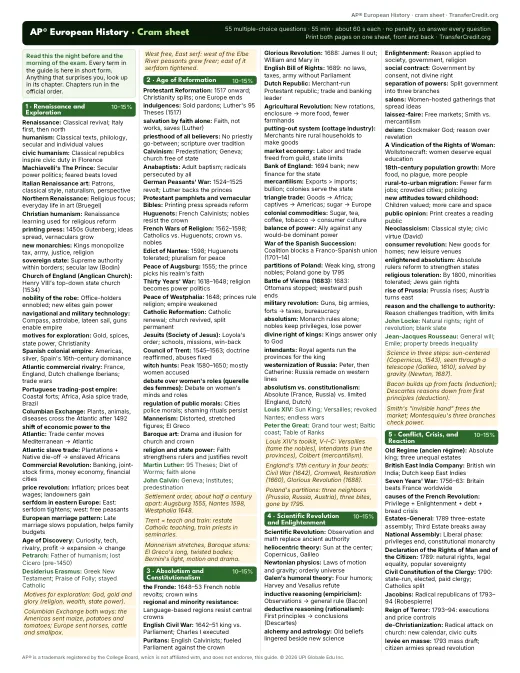
Page 9 of the TransferCredit.org Guide to AP® European History: a chapter quiz
Page 9 A chapter quiz
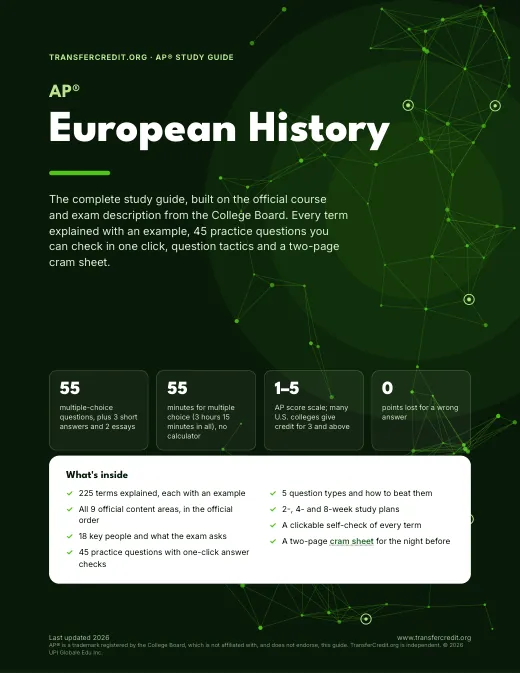
Page 53 of the TransferCredit.org Guide to AP® European History: the 2-page cram sheet
Page 53 The 2-page cram sheet

What you get for $5

One chapter for each area of the official course and exam description, in the official order.

  • 📘54pages, printable
  • 🧭9chapters
  • 🔑225terms with examples
  • ✍️45practice questions, answers explained
  • ⚠️27exam traps to avoid
  • 📄2page cram sheet

Try 10 free AP® European History questions

Multiple-choice questions taken from the guide's chapter quizzes: 9 areas, heaviest first. About 10 minutes, with every answer explained and a score by area. The exam's free-response questions aren't in this quiz: see how the exam works.

10 questions  
  1. Question 1 · Renaissance and Exploration
    Questions 1–3 refer to the source described below.
    In his Oration on the Dignity of Man (1486), the Italian humanist Giovanni Pico della Mirandola imagined God telling Adam that, unlike other creatures, he had been given no fixed nature: by his own choices he could sink to the level of the beasts or rise toward the divine.
    Which Renaissance idea does the source express most clearly?
    Show the answer

    Answer: A. Confidence that individuals can shape their own nature and destiny. Pico has God tell Adam that he can make himself whatever he chooses, rising or sinking by his own decision. That is the humanist confidence in individual human potential, part of the Renaissance turn toward individualism.

    The trap: Salvation by faith alone was Luther's teaching after 1517; Pico's point is human free choice, not how sinners are saved.

  2. Question 2 · Age of Reformation
    Questions 1–3 refer to the excerpt below.
    “. . . each community should choose and appoint a pastor, and that we should have the right to depose him should he conduct himself improperly. The pastor thus chosen should teach us the gospel pure and simple, without any addition, doctrine, or ordinance of man. . . . It has been the custom hitherto for men to hold us as their own property, which is pitiable enough, considering that Christ has delivered and redeemed us all, without exception, by the shedding of his precious blood, the lowly as well as the great. Accordingly it is consistent with Scripture that we should be free and should wish to be so.”
    The Twelve Articles, demands of peasants in Upper Swabia (southern Germany), 1525
    The excerpt is best understood in the context of
    Show the answer

    Answer: C. ordinary people applying reformers' appeals to scripture to their own grievances. The peasants justify a church demand (electing a pastor who preaches the Gospel "pure and simple") and a social one (ending serfdom) by appealing to scripture, as Luther had. Reformation challenges to authority spread beyond theology.

    The trap: French nobles did use Calvinism to resist royal control of religion (the Huguenots), but this excerpt comes from German peasants seeking freedom from serfdom, not nobles resisting a king.

  3. Question 3 · Absolutism and Constitutionalism
    Questions 1–3 refer to the two excerpts below.
    Source 1
    “It appears from all this that the person of the king is sacred, and that to attack him in any way is sacrilege. . . . The royal power is absolute. . . . The prince need render account of his acts to no one.”
    Jacques-Bénigne Bossuet, French bishop and tutor to the son of Louis XIV, Politics Drawn from the Very Words of Holy Scripture, published 1709
    Source 2
    “That the pretended power of suspending the laws or the execution of laws by regal authority without consent of Parliament is illegal; . . . That levying money for or to the use of the Crown by pretence of prerogative, without grant of Parliament . . . is illegal; . . . That election of members of Parliament ought to be free . . .”
    English Bill of Rights, 1689
    The two excerpts differ most in their views about whether
    Show the answer

    Answer: B. a ruler's power should be limited by an elected assembly. Bossuet says royal power is absolute and the king answers to no one. The Bill of Rights says the crown may not suspend laws or raise money without Parliament's consent and that elections to Parliament must be free. (Pretended here means claimed.)

    The trap: Bossuet does say kings will answer to God, and the Bill of Rights doesn't deny it; the real disagreement is over earthly limits on royal power.

  4. Question 4 · Scientific Revolution and Enlightenment
    Questions 1–3 refer to the excerpt below.
    “Women are, therefore, to be considered either as moral beings, or so weak that they must be entirely subjected to the superior faculties of men. . . . ‘Educate women like men,’ says Rousseau, ‘and the more they resemble our sex the less power will they have over us.’ This is the very point I aim at. I do not wish them to have power over men; but over themselves.”
    Mary Wollstonecraft, A Vindication of the Rights of Woman, 1792
    Wollstonecraft's argument in the excerpt most directly drew on
    Show the answer

    Answer: D. Enlightenment ideals of reason, natural rights and human equality. Wollstonecraft turns the Enlightenment's own principles against thinkers like Rousseau: if women are rational, moral beings, they deserve the same education as men and should govern themselves.

    The trap: Romantics prized feeling over reason, but Wollstonecraft's case rests on women's capacity for reason, the very faculty she says education should develop.

  5. Question 5 · Conflict, Crisis, and Reaction
    Questions 1–3 refer to the source described below.
    In a February 1794 speech to the National Convention, Maximilien Robespierre said that the republic must crush its enemies at home and abroad or perish. Popular government in peacetime rests on virtue, he argued, but in a revolution it needs both virtue and terror: terror without virtue is deadly, and virtue without terror is helpless.
    The speech was most likely intended to
    Show the answer

    Answer: B. justify harsh measures against the republic's enemies in wartime. Robespierre argues that in a revolution, virtue needs terror to defeat the republic's internal and external enemies. He was defending the Terror carried out by the Committee of Public Safety during war and civil revolt.

    The trap: Robespierre led a republic that had already executed Louis XVI; restoring the king was the opposite of his aim.

  6. Question 6 · Industrialization and Its Effects
    Questions 1–3 refer to the two excerpts below.
    Source 1
    “. . . in the factory, every member of the loom is so adjusted, that the driving force leaves the attendant nearly nothing at all to do, certainly no muscular fatigue to sustain, while it procures for him good, unfailing wages, besides a healthy workshop gratis . . . . The constant aim and effect of scientific improvement in manufactures are philanthropic . . .”
    Andrew Ure, Scottish professor, The Philosophy of Manufactures, 1835
    Source 2
    “. . . the working-people's quarters are sharply separated from the sections of the city reserved for the middle-class . . . . Everywhere heaps of débris, refuse, and offal; standing pools for gutters, and a stench which alone would make it impossible for a human being in any degree civilised to live in such a district.”
    Friedrich Engels, German socialist and son of a textile manufacturer, describing Manchester in The Condition of the Working Class in England, 1845
    The difference between the two sources is best explained by the fact that
    Show the answer

    Answer: A. Ure defended factory owners, while Engels criticized capitalism. Point of view explains the contrast. Ure, a professor who championed manufacturers, presented machines as kind to workers; Engels, a German socialist working in his family's Manchester firm, set out to expose how industrial capitalism treated workers.

    The trap: Parliament never banned all child labor in this period; the Factory Act of 1833 only limited it. Engels's subject here is housing, not factory hours.

  7. Question 7 · 19th-Century Perspectives
    Questions 1–3 refer to the source described below.
    In an 1884 speech to the French Chamber of Deputies, Prime Minister Jules Ferry argued that French industry needed colonies as outlets for its exports, because Germany next door and the United States across the ocean were raising trade barriers. He also claimed that superior races had a right over inferior races and a duty to civilize them.
    Ferry's argument most directly reflects which of the following motives for the New Imperialism?
    Show the answer

    Answer: C. Finding markets for French goods while claiming a duty to rule other races. Ferry argues that French industry needs outlets because rival nations are closing their markets, and he claims that supposedly superior races have a right and duty to rule others. Economic need plus claimed racial superiority sums up the New Imperialism's main justifications.

    The trap: France's population grew slowly in the 1800s, and Ferry's case rests on markets for industry, not on settlers.

  8. Question 8 · 20th-Century Global Conflicts
    Questions 1–3 refer to the table below.
    Nazi Party share of the vote in elections to the German Reichstag (parliament)
    May 1928: 2.6%
    September 1930: 18.3%
    July 1932: 37.3%
    November 1932: 33.1%
    The change in the Nazi share of the vote between 1928 and July 1932 was most directly caused by
    Show the answer

    Answer: D. the economic crisis that followed the 1929 Wall Street crash. The Nazi vote jumped after the Depression hit Germany: American loans were recalled, unemployment soared, and voters abandoned Weimar's governing parties for extremes.

    The trap: Hyperinflation struck in 1923, when the Nazis were still a fringe group; in 1928, after years of recovery, they won only 2.6% of the vote.

  9. Question 9 · Cold War and Contemporary Europe
    Questions 1–3 refer to the excerpt below.
    “The coming together of the nations of Europe requires the elimination of the age-old opposition of France and Germany. . . . The pooling of coal and steel production should immediately provide for the setting up of common foundations for economic development as a first step in the federation of Europe . . . . The solidarity in production thus established will make it plain that any war between France and Germany becomes not merely unthinkable, but materially impossible.”
    Robert Schuman, French foreign minister, declaration, 1950 (English text © European Union, CC BY 4.0; excerpted)
    The proposal in the excerpt was most directly a response to
    Show the answer

    Answer: D. the destruction of two world wars in which France and Germany were enemies. Writing five years after World War II, Schuman proposed tying French and German heavy industry together so the two countries, enemies in 1870, 1914 and 1939, could never again make war on each other.

    The trap: The 1970s oil shocks came two decades after this 1950 proposal, so they could not have prompted it.

  10. Question 10 · Renaissance and Exploration
    Refer to the source in question 1.
    Pico's ideas were most directly shaped by
    Show the answer

    Answer: C. the humanist revival of ancient Greek and Roman texts. Pico studied newly recovered works of Plato and other ancient writers among the humanists of Florence, and his oration draws on ancient authorities to praise human dignity.

    The trap: Luther's pamphlets came after 1517, three decades after this 1486 oration, so they could not have shaped it.

The AP® European History exam at a glance

The AP® European History exam is from the College Board. It has 55 multiple-choice questions, plus 3 short answers and 2 essays. You get 55 minutes for multiple choice (3 hours 15 minutes in all), no calculator. The score scale is 1–5 (AP® score scale; many U.S. colleges give credit for 3 and above). The guide has 9 chapters, one for each area of the official course and exam description; its 9 units carry the same weight (10–15% each).

Questions
55multiple-choice questions, plus 3 short answers and 2 essays
Time
55 minfor the 55 multiple-choice questions, about 60 seconds a question
Score
1–5AP® score scale; many U.S. colleges give credit for 3 and above
Fee
$99per exam in the U.S. and Canada in 2026-27; your school may charge more
Calculator
Nonot allowed
Wrong answers
No penaltya wrong answer costs nothing
  • Section I has 55 multiple-choice questions in 55 minutes (40% of your score), usually in sets of 3–4 questions on one or more sources, then 3 short-answer questions in 40 minutes (20%).
  • Section II has a document-based question with 7 documents (recommended 60 minutes, including a 15-minute reading period; 25%) and a long essay question (recommended 40 minutes; 15%).
  • From the May 2027 exam, all 3 short-answer questions are required and each includes a source; the long essay is one required question.
  • The exam is fully digital: you answer every question in the Bluebook testing app. No calculator is allowed. Your multiple-choice score is the number of questions you answer correctly, so a wrong answer costs nothing.
  • The course runs from about 1450 to the present, and each of the 9 units is 10–15% of the exam. Unit dates are approximate: developments can begin before or continue after them.

Source: official AP® European History page and the official course and exam description. Last updated 2026.

What the exam covers

9 chapters, in the official order, with each area's official weight. The guide's chapters follow this order.

  1. Renaissance and Exploration10–15% · ~6–8 Q
  2. Age of Reformation10–15% · ~6–8 Q
  3. Absolutism and Constitutionalism10–15% · ~6–8 Q
  4. Scientific, Philosophical, and Political Developments10–15% · ~6–8 Q
  5. Conflict, Crisis, and Reaction in the Late 18th Century10–15% · ~6–8 Q
  6. Industrialization and Its Effects10–15% · ~6–8 Q
  7. 19th-Century Perspectives and Political Developments10–15% · ~6–8 Q
  8. 20th-Century Global Conflicts10–15% · ~6–8 Q
  9. Cold War and Contemporary Europe10–15% · ~6–8 Q

Where to start: all 9 units carry the same weight (10–15% each), so give each one equal time.

AP® European History study guide by area

The 3 heaviest areas are open to read now. The full guide has a chapter for every area, each with all its terms, a quiz and an answer key.

3 of 9 chapters open  ·  in the guide's order
10–15% · about 6–8 questions · free preview Renaissance and Exploration Chapter 1 of the guide

From about 1450 to 1648, Europeans revived Greek and Roman learning, spread it with the printing press, and sailed overseas to build trading empires and colonies. Questions ask how humanism changed scholarship, art and politics, why states explored, and how expansion reshaped Europe's economy and the peoples Europeans met. At home, most people still farmed for their own needs, while migrants crowding into cities strained town governments and guilds.

Key terms, with examples

Renaissance
A cultural revival, begun in the Italian city-states before 1450, in which rediscovered Greek and Roman works and observation of nature changed how Europeans saw their world.
Example: Scholars searched monastery libraries for lost Latin texts, while artists studied Roman ruins and live models to show the world realistically.
Northern Renaissance
The Renaissance as it spread beyond Italy; it kept a more religious focus, and its human-centered naturalism made individuals and everyday life fit subjects for art.
Example: Pieter Bruegel the Elder painted Flemish peasants at weddings, harvests and village dances, showing ordinary life in close detail.
new monarchies
Late-1400s rulers who laid the base of the centralized state by monopolizing taxes, armed force and justice and by choosing their subjects' religion.
Example: Ferdinand and Isabella put Spain's armed forces under royal command and used the Spanish Inquisition to enforce Catholic unity.
navigational and military technology
Tools that let Europeans sail far, find their way and win fights overseas: compass, astrolabe, lateen sail, sternpost rudder, portolan charts and gunpowder weapons.
Example: Portuguese caravels used triangular lateen sails to sail against the wind, carrying explorers down Africa's coast.
Portuguese trading-post empire
Portugal's late-15th- and 16th-century network of forts and trading posts along Africa's coast and in South and East Asia, plus its colony in Brazil.
Example: After Vasco da Gama reached India in 1498, Portugal seized Goa and Malacca and settled Macao to dominate the seaborne spice trade.
Commercial Revolution
Innovations in banking and finance, from the 15th to 17th centuries, that grew urban financial centers and a money economy, including joint-stock companies.
Example: Italian merchants spread double-entry bookkeeping, and the Dutch East India Company (1602) raised capital by selling shares to many investors.
Age of Discovery
Europe's era of overseas voyages and conquest after about 1450, driven by curiosity, new technology, state rivalry, profit and religion, which reshaped Europe's economy and society.
Example: Columbus's 1492 voyage, backed by Spain's new monarchy, began exchanges that brought silver, sugar and slavery into Europe's economy.
humanism
A Renaissance movement that revived classical literature and used new philological (text-critical) methods to study ancient texts; some humanists also furthered secularism and individualism.
Example: Lorenzo Valla showed that the Donation of Constantine, used to back papal power, was written in Latin too late for Constantine's time: a forgery.
Christian humanism
The use of Renaissance learning, especially study of the Bible and early Church writers in their original languages, for religious reform; strongest in northern Europe.
Example: In Utopia (1516), Thomas More imagined an ideal island society to criticize greed and injustice in Christian Europe.
sovereign state
A state whose ruler holds supreme authority within its borders, under no pope or emperor; this idea and secular law shaped new political institutions.
Example: The French jurist Jean Bodin argued in 1576 that every state needs one sovereign power that makes law and cannot be divided.
motives for exploration
Why states sent voyages overseas: direct access to gold, spices and luxury goods for wealth and power; mercantilist promotion of trade and colonies; and spreading Christianity.
Example: Jesuit missionaries followed traders to India, Japan and Brazil, while some conquerors cited conversion to justify subjugating Native peoples.
Columbian Exchange
The post-1492 transfer of plants, animals and diseases between the Americas and Afro-Eurasia; it enriched Europeans and aided their conquest and destruction of Native societies.
Example: Maize and tomatoes crossed to Europe, horses and cattle spread across the Americas, and smallpox killed millions of Native Americans.

What this area covers

The Renaissance in ItalyThe Renaissance spreads northNew monarchiesExploration and rival empiresColumbian Exchange and the slave tradeThe Commercial Revolution and rural lifeCauses and consequences

Key people

PetrarchItalian poet and scholar of the 1300s, before this course's period, who tracked down lost works by Cicero and wrote letters addressed to ancient authors; often called the father of humanism.
Desiderius ErasmusDutch scholar who published a Greek edition of the New Testament (1516) and mocked church abuses in The Praise of Folly, yet stayed Catholic and broke with Luther.

How the exam asks it

Expect excerpts from humanists, explorers and rulers, images of Renaissance art, and maps or charts of trade. Questions ask what a source shows about Renaissance values, why Europeans explored, and how overseas expansion changed Europe's economy and society and the peoples Europeans met. Link causes to effects: printing spread humanism, new technology and state rivalry drove expansion, and the Columbian Exchange fed both European wealth and the slave trade.

Common traps

Trap 1. Don't treat the Renaissance as anti-religious. Most humanists were Christians; secular values grew, but northern humanists used the new learning for religious reform.

Trap 2. The price revolution hurt wage earners but helped large landowners and merchants with capital. Don't call it good or bad for everyone.

Trap 3. Spain dominated in the 1500s; France, England and the Dutch challenged it in the 1600s. Check which century the question names.

Memory trick

Motives for exploration: God, gold and glory (religion, wealth, state power).

Columbian Exchange both ways: the Americas sent maize, potatoes and tomatoes; Europe sent horses, cattle and smallpox.

10–15% · about 6–8 questions · free preview Age of Reformation Chapter 2 of the guide

Beginning in 1517, Martin Luther's challenge to the Catholic Church split Western Christianity, and religious pluralism ended the idea of one Christian Europe. This chapter covers Protestant and Catholic reform, the wars of religion that ended with the Peace of Westphalia (1648), and how the upheaval changed society, women's roles and art.

Key terms, with examples

Protestant Reformation
The movement begun by Luther in 1517 that split Western Christianity. It let rulers take control of churches but also gave subjects religious grounds to resist them.
Example: By 1600 Lutheran, Calvinist, Anglican and Catholic churches divided Europe, so religious pluralism replaced the ideal of one Christian community.
indulgences
Church grants that reduced the punishment due for sins, often sold for money. Their sale was the abuse that first moved Luther to protest.
Example: In 1517 Luther's Ninety-Five Theses attacked a preacher selling indulgences to pay for rebuilding St. Peter's Basilica in Rome.
Protestant pamphlets and vernacular Bibles
Printed tracts, woodcuts and Bibles in everyday languages that spread reform ideas quickly and cheaply, helping Protestantism take root among ordinary people.
Example: Luther's German New Testament (1522) was reprinted many times, letting townspeople judge church teaching against scripture.
French Wars of Religion
Civil wars (1562–1598) between Catholics and Huguenots in which religious division worsened conflicts between the monarchy and the nobility.
Example: In 1572 the St. Bartholomew's Day Massacre, linked to Catherine de' Medici, killed thousands of Huguenots in Paris and other towns.
Catholic Reformation
The Catholic Church's 16th-century renewal and response to Protestantism, which revived Catholic faith and discipline but cemented the split within Christianity.
Example: The Roman Inquisition tried heretics, the Index of Prohibited Books banned Protestant works, and the Ursulines founded schools for girls.
witch hunts
Waves of witchcraft trials, peaking between 1580 and 1650, fed by folk beliefs and social, economic and religious upheaval; most of those accused were women.
Example: Accused women, often poor, older or widowed, were often tortured into naming others, so one charge in a village could spark many trials.
Mannerism
A 16th-century style, after the High Renaissance, that used distortion, odd proportions, strained poses and dramatic color in place of Renaissance balance.
Example: El Greco painted stretched, flame-like figures under stormy skies in religious scenes for churches in Toledo, Spain.
religion and state power
The era's central pattern: reform let rulers control churches yet justified resistance, religious wars mixed faith with power politics, and Westphalia left religion to states.
Example: Henry VIII made himself head of England's church, while French Huguenots and Dutch Calvinists took up arms against Catholic kings.
salvation by faith alone
Luther's teaching that people are saved only by faith in God's grace, not by good works, pilgrimages or buying indulgences.
Example: Lutheran towns closed their monasteries, since vows and good works could no longer be seen as a path to heaven.
Huguenots
French Calvinists, many of them nobles, whose faith became a basis for challenging the French crown's control of religion and, at times, its authority.
Example: Like Puritans resisting England's bishops and Polish nobles defending religious liberty, Huguenot nobles raised armies and held fortified towns against the crown.
Edict of Nantes
Henry IV's 1598 decree granting Huguenots freedom of worship in set places and civil rights, accepting religious pluralism to keep domestic peace.
Example: Henry IV, a former Huguenot who became Catholic to win Paris, kept France Catholic while letting Protestants worship and hold office.
Jesuits (Society of Jesus)
The order founded by Ignatius of Loyola and approved in 1540 that spread Catholicism through schools, missions and preaching and worked to win back Protestant regions.
Example: Jesuit colleges educated the sons of Catholic nobles in Poland and Bavaria, while missionaries such as Francis Xavier preached in Asia.

What this area covers

The Reformation in contextLuther, Calvin and the radicalsSpreading reform, challenging kingsWars of religion and the peace settlementsThe Catholic ReformationSociety, women and public moralsMannerism and BaroqueThe big picture

Key people

Martin LutherGerman monk and Wittenberg professor. Excommunicated by the pope, he refused to recant before Emperor Charles V at the Diet of Worms (1521) and was sheltered by the elector of Saxony.
John CalvinFrench-born reformer who wrote the Institutes of the Christian Religion (1536) and from 1541 led the church in Geneva, which trained preachers for France, Scotland and the Netherlands.

How the exam asks it

Expect excerpts from reformers, peasants, rulers and church councils, and images of Baroque art. Questions ask why a group took up or resisted reform, how rulers used religion for political ends, and how the Peace of Augsburg, the Edict of Nantes and the Peace of Westphalia handled religious division. Keep both sides of the link in mind: reform strengthened rulers' control of churches, and it also gave subjects reasons to resist them.

Common traps

Trap 1. Toleration in this era was a practical bargain to end wars, not a belief in freedom of conscience. Toleration as a principle spread with the Enlightenment (Unit 4).

Trap 2. Under the Peace of Augsburg the prince, not each subject, chose the faith, and only Lutheranism or Catholicism counted. Calvinists were left out until 1648.

Trap 3. In a "war of religion" question, look for political motives too. Rulers backed foreign coreligionists, or even rival faiths, when it weakened a rival dynasty.

Memory trick

Settlement order, about half a century apart: Augsburg 1555, Nantes 1598, Westphalia 1648.

Trent = teach and train: restate Catholic teaching, train priests in seminaries.

10–15% · about 6–8 questions · free preview Absolutism and Constitutionalism Chapter 3 of the guide

From 1648 to 1815, rulers tried to concentrate power, with different results: absolute monarchy in France, Prussia, Austria and Russia, but Parliament's supremacy in England and a merchant-run republic in the Netherlands. Meanwhile a market economy, colonial trade built on enslaved labor, and wars fought for a balance of power reshaped states and daily life.

Key terms, with examples

the Fronde
French revolts of 1648–1653, during Louis XIV's childhood, by nobles and the Paris parlement defending their traditional share of power against royal centralization.
Example: In 1649 rebels forced the young king and his mother, the regent, to flee Paris, an experience that shaped Louis XIV's distrust of nobles.
English Civil War
The 1642–1651 war among the monarchy, Parliament and other elites over their roles in government, fought partly over religion; Parliament won and executed Charles I in 1649.
Example: From 1653 the army leader Oliver Cromwell ruled as Lord Protector until his death in 1658; monarchy returned in 1660.
Agricultural Revolution
Farming changes of the 1600s–1700s, such as new crop rotations and enclosure, that raised productivity, grew more food with fewer workers and let population grow.
Example: English farmers sowed turnips and clover instead of leaving fields fallow; as enclosure spread, displaced laborers moved to towns to find work.
mercantilism
The policy that a state grows rich by exporting more than it imports and piling up gold and silver, drawing raw materials and markets from colonies.
Example: Louis XIV's minister Colbert subsidized French industries, built roads and canals, raised tariffs and chartered overseas trading companies.
balance of power
The principle that states ally to keep any one power from dominating Europe; after 1648 it and dynastic and colonial aims, not religion, drove most wars.
Example: In 1756 old enemies France and Austria became allies to check Prussia's rise, while Britain sided with Prussia.
absolutism
Rule by a monarch claiming sole, unlimited authority; common in 17th- and 18th-century Europe, it cut nobles' role in governing but kept their social rank and privileges.
Example: Prussia's kings ruled through a royal army and bureaucracy, while Junker nobles kept their estates, serfs and officer posts.
absolutism vs. constitutionalism
Two models of early modern rule: monarchs governing without assemblies (France, Russia) versus power limited by Parliament or merchant elites (England, the Dutch Republic).
Example: France's Estates-General did not meet between 1614 and 1789, while England's Parliament met every year after 1689 to vote taxes.
regional and minority resistance
Opposition to a state's dominant national group by regions or minorities with their own language, culture or liberties, which limited how far monarchs could centralize.
Example: In 1640 Catalonia revolted against Spanish demands for troops and taxes; Bohemia's Czech nobles had defied Habsburg rule in 1618.
Puritans
English Calvinists who wanted to purge the Church of England of Catholic practices; their religious conflict with the crown fed Parliament's challenge to royal control.
Example: Many members of Parliament and soldiers of its New Model Army were Puritans who opposed Archbishop Laud's elaborate church rituals.
putting-out system (cottage industry)
Rural production in which merchants supplied raw materials to laborers working in their homes or small workshops, then collected the finished goods to sell in wider markets.
Example: A merchant left raw wool with a farm family, who spun and wove it at home and were paid by the piece.
triangle trade
The 17th- and 18th-century Atlantic system in which European goods went to Africa, enslaved Africans to the Americas, and plantation products such as sugar to Europe.
Example: Rising European demand for sugar drew more enslaved Africans across the Middle Passage, where many died in crowded, disease-ridden ships.
War of the Spanish Succession
The 1701–1714 war in which Britain, the Dutch and Austria fought Louis XIV to prevent a union of France and Spain after his grandson inherited the Spanish throne.
Example: The Treaty of Utrecht (1713) let Philip V keep Spain but barred any union of the crowns and gave Britain Gibraltar.

What this area covers

Monarchs against nobles and regionsAlternatives to absolutism: England and the DutchA market economyMercantilism and colonial tradeBalance of power and warAbsolute monarchyComparing the two models

Key people

Louis XIVKing of France (1643–1715) who ruled without a chief minister after 1661, moved the court to Versailles to keep nobles close, revoked the Edict of Nantes in 1685 and fought nearly continuous wars.
Peter the GreatRussian tsar (1682–1725) who toured western Europe in disguise, built a navy, defeated Sweden in the Great Northern War to win a Baltic coastline, and tied nobles' rank to state service.

How the exam asks it

Expect writings by kings and their defenders, parliamentary documents, images of Versailles or St. Petersburg, and charts of trade. Questions ask you to compare absolute and constitutional states, explain why England's Parliament won while France's nobles lost, and connect mercantilism, the slave-labor system and the market economy to Europe's growing wealth. Know that after 1648 wars were fought for dynasty, territory and trade, and that coalitions formed to stop any one state from dominating.

Common traps

Trap 1. Absolutism did not abolish the nobility. Absolute monarchs cut nobles' political power but protected their social rank, estates and tax privileges.

Trap 2. The Glorious Revolution was not a democratic revolution: it gave power to Parliament, which represented landowning elites, not ordinary people.

Trap 3. After 1648, don't explain wars mainly by religion. Alliances such as Protestant Britain with Catholic Austria show that power and trade came first.

Memory trick

Louis XIV's toolkit, V-I-C: Versailles (tame the nobles), Intendants (run the provinces), Colbert (mercantilism).

England's 17th century in four beats: Civil War (1642), Cromwell, Restoration (1660), Glorious Revolution (1688).

How AP® European History questions are written

The exam has 55 multiple-choice questions, plus 3 short answers and 2 essays. The guide sorts the questions into 5 types; spot the type and you'll know what the question wants before you read the choices.

Type 1

Name the development a source shows

A source, then “Which development does the excerpt best show?” or “The pattern described most directly resulted from . . .” (Developments and Processes)

  • Read the citation first: who, when and what kind of source.
  • Say in a few words what is happening, then name the course development that matches.
  • Cross out choices from the wrong century or the wrong region.
Type 2

Read a source's point of view, purpose, audience or situation

“The author's purpose was most likely to . . .”, “The excerpt was most likely intended for . . .” or “The historical situation that shaped the excerpt was . . .” (Sourcing and Situation)

  • Use the citation: who wrote it, when, in what role and for whom.
  • Ask what the author wanted to happen as a result.
  • Pick the choice that fits both the words and the author's position at that time.
Type 3

Find the claim, or the evidence that supports it

A historian's interpretation, sometimes two to compare, then “Which of the following would best support the argument?” or “The author's main claim is that . . .” (Claims and Evidence in Sources)

  • Restate the claim in one short sentence of your own.
  • For a support question, choose a fact that proves that claim, not just any true fact from the period.
  • For a challenge question, choose a fact that cuts against the claim.
Type 4

Place a source in its context

“Which of the following contributed most directly to the developments in the excerpt?” or “The excerpt was written in the context of . . .” (Contextualization)

  • Find the date in the citation and recall the big story of that period.
  • Ask what was happening just before the source that would make someone write it.
  • Choose the broad development that best explains it; drop events that came later.
Type 5

Connect developments: causes, effects, comparisons and change

“Which of the following was most similar to . . .?”, “. . . most directly led to . . .” or “. . . was a continuation of . . .” (Making Connections)

  • Name the reasoning the question asks for: cause, effect, comparison, or continuity and change.
  • State the key feature of the development in the source.
  • Find the choice that shares that feature (comparison) or follows from it (effect).

Test-day habits that add points

  1. Answer every question. There's no penalty for a wrong answer. A blank is always worth zero, so never leave one.
  2. Predict, then look. Name the answer before reading the choices. It protects you from distractors written to sound right.
  3. Eliminate. Cross out choices you know are wrong. Every choice you rule out raises your odds on a guess.
  4. Mark and move on. If a question takes more than a minute, pick your best guess, mark it and come back if time allows.
  5. Watch absolute words. Choices with "always", "never" or "only" are often wrong, because most rules and findings have exceptions. Treat this as a tiebreaker, not a rule.
  6. Change answers for a reason. Switch an answer only when you can say why the new one is better, such as a detail you missed.
  7. The short-answer questions. 3 required questions in 40 minutes, 20% of your score. Question 1 uses a secondary text source, question 2 a primary text source, question 3 a primary or secondary non-text source; together they cover 1450–2001, and each focuses on a different period. In the CED's sample, parts (a), (b) and (c) earn 1 point each.
  8. The document-based question. One essay on 7 documents: recommended 60 minutes, including a 15-minute reading period; 25% of your score; a topic within 1450–2001. 7 points: thesis 1, contextualization 1, document evidence up to 2 (content of at least 3 documents = 1; at least 4 used to support an argument = 2), evidence beyond the documents 1, sourcing of at least 2 documents 1, complex understanding 1.
  9. The long essay question. You answer one required long essay question in a recommended 40 minutes, worth 15% of your score. The prompt covers about half of the course's chronological scope; you need not cover the whole span. It is scored out of 6 points: thesis 1, contextualization 1, evidence up to 2, and analysis and reasoning up to 2.

Pacing: 55 questions in 55 minutes, about 60 seconds a question.

AP® European History flashcards

Try the first 8 cards free. Read the term, say the definition out loud, then select the card to check yourself. Arrow keys move between cards.

Free card 1 of 8 (deck total: 225)

How to study for AP® European History: a 5-step plan

Follow the steps, then enter your test date. The planner gives you a dated plan that starts with the heaviest areas and saves the last days for review.

  1. Take the 10 free questionsSee which AP® European History areas you already know.
  2. Study the heaviest areas firstStart with Renaissance and Exploration, Age of Reformation and Absolutism and Constitutionalism, then work down the exam map.
  3. Learn each term with an exampleSay the definition out loud, then check it with the flashcards. A term you can't use in an example isn't learned yet.
  4. Quiz yourself and study the trapsAfter each area, answer its quiz and read why the tempting wrong answer is wrong.
  5. Plan backwards from your exam dateBuild a dated plan, keep the last days for a full review, and read the cram sheet the night before.

How it works

  1. 1Check outSelect Get the guide · $5 and pay on TransferCredit.org's secure checkout.
  2. 2Download the PDFFrom your TransferCredit.org account.
  3. 3Study the heaviest areas firstFollow the 2-, 4- or 8-week plan, then read the cram sheet the night before.

This page or the full guide

Everything on this page is free with no account. The full guide is a PDF you keep.

What's on this page and in the full study guide
Study toolThis pageFull study guide ($5)
ChaptersA preview of 3 of 9All 9
Terms explainedA sample from the open chaptersAll 225, each with an example
Practice questions10 free questions45, with an answer key
Flashcards8 cardsAll 225 terms on the self-check list
Study planDated planner2-, 4- and 8-week plans
Cram sheet—2 pages, for the night before
FormatWeb page54-page PDF, printable

Questions students ask

What's in the full AP® European History study guide?
54 pages: 9 chapters, one for each area of the College Board's official course and exam description, in the official order. 225 terms, each with a plain-English definition and an example, 18 key people, common traps and memory tricks, 45 practice questions with an answer key that explains every answer, question tactics, 2-, 4- and 8-week study plans and a 2-page cram sheet.
How much is the full AP® European History study guide?
The full 54-page PDF is $5. The 10 practice questions on this page are free.
How do I get the full guide?
Select Get the guide · $5 and check out on TransferCredit.org. Then sign in to your TransferCredit.org account to download the PDF.
Can I print the guide or use it on my phone?
Yes. It's a PDF, so it opens on phones, tablets and computers, and printing is allowed. Its tick boxes and answer bubbles work in PDF readers that support forms. Copying and editing are turned off.
Can I try the AP® European History guide before I buy it?
Yes. This page has 10 questions from the guide's own chapter quizzes, a preview of the 3 heaviest areas, 8 flashcards and a study planner. No account needed.
Is this an official AP® study guide?
No. AP® is a trademark registered by the College Board, which is not affiliated with, and does not endorse, this guide. TransferCredit.org is independent. We built the guide from the College Board's official course and exam description, and the exam details were checked against the College Board's published exam information in 2026.
How was this study guide made?
One chapter for each area of the official course and exam description, using its published weights. Each chapter was written, then fact-checked against the official exam information in a separate review. The practice questions are original: none are copied from the College Board's released questions.
How up to date is this AP® European History guide?
Last updated 2026. The exam details were checked against the College Board's published exam information in 2026. Exams change, so confirm the details on the official AP® European History page before you test.
More questions about the AP® European History exam (16)
What is the AP® European History exam?
The AP® European History exam is from the College Board. It has 55 multiple-choice questions, plus 3 short answers and 2 essays. You get 55 minutes for multiple choice (3 hours 15 minutes in all), no calculator. The score scale is 1–5 (AP® score scale; many U.S. colleges give credit for 3 and above). The guide has 9 chapters, one for each area of the official course and exam description; its 9 units carry the same weight (10–15% each).
How many questions are on the AP® European History exam, and how long is it?
Section I has 55 multiple-choice questions in 55 minutes (40% of your score), usually in sets of 3–4 questions on one or more sources, then 3 short-answer questions in 40 minutes (20%). Section II has a document-based question with 7 documents (recommended 60 minutes, including a 15-minute reading period; 25%) and a long essay question (recommended 40 minutes; 15%).
How is the AP® European History exam scored?
The score scale is 1–5: AP® score scale; many U.S. colleges give credit for 3 and above. Your multiple-choice score is the number of questions you answer correctly, so a wrong answer costs nothing.
What AP® European History score do I need for college credit?
Many U.S. colleges give credit for 3 and above. Each college sets its own credit policy, so check the one at your college before you count on the credit.
How much does the AP® European History exam cost?
The fee is $99: per exam in the U.S. and Canada in 2026-27; your school may charge more. Fees can change, so check the official page when you register.
Can I use a calculator on the AP® European History exam?
No calculator is allowed.
Is there a penalty for guessing on AP® European History?
No. There's no penalty for a wrong answer. A blank is always worth zero, so never leave one.
What topics are on the AP® European History exam?
9 areas, from the official course and exam description: Renaissance and Exploration (10–15%); Age of Reformation (10–15%); Absolutism and Constitutionalism (10–15%); Scientific, Philosophical, and Political Developments (10–15%); Conflict, Crisis, and Reaction in the Late 18th Century (10–15%); Industrialization and Its Effects (10–15%); 19th-Century Perspectives and Political Developments (10–15%); 20th-Century Global Conflicts (10–15%); Cold War and Contemporary Europe (10–15%).
Which AP® European History topics should I study first?
All 9 units carry the same weight (10–15% each), so give each one equal time.
Is the AP® European History exam hard?
It depends on what you already know. The 9 units carry the same weight, so broad coverage matters more than depth in one unit. Try the 10 free questions above to see where you stand in about 10 minutes.
What kinds of questions are on the AP® European History exam?
The exam has 55 multiple-choice questions, plus 3 short answers and 2 essays. The guide sorts the questions into 5 types: “Name the development a source shows”, “Read a source's point of view, purpose, audience or situation”, “Find the claim, or the evidence that supports it”, “Place a source in its context” and “Connect developments: causes, effects, comparisons and change”. Multiple-choice questions have 4 answer choices. See how each type is written.
What are the free-response questions on the AP® European History exam?
3 required questions in 40 minutes, 20% of your score. Question 1 uses a secondary text source, question 2 a primary text source, question 3 a primary or secondary non-text source; together they cover 1450–2001, and each focuses on a different period. In the CED's sample, parts (a), (b) and (c) earn 1 point each. One essay on 7 documents: recommended 60 minutes, including a 15-minute reading period; 25% of your score; a topic within 1450–2001. 7 points: thesis 1, contextualization 1, document evidence up to 2 (content of at least 3 documents = 1; at least 4 used to support an argument = 2), evidence beyond the documents 1, sourcing of at least 2 documents 1, complex understanding 1. You answer one required long essay question in a recommended 40 minutes, worth 15% of your score. The prompt covers about half of the course's chronological scope; you need not cover the whole span. It is scored out of 6 points: thesis 1, contextualization 1, evidence up to 2, and analysis and reasoning up to 2.
How should I pace myself on the AP® European History exam?
55 questions in 55 minutes, about 60 seconds a question. If a question takes more than a minute, pick your best guess, mark it and come back if time allows.
How long should I study for AP® European History?
Take the 10 free questions to see where you stand. The full guide has 2-, 4- and 8-week plans built from the exam weights, and the planner on this page builds a dated plan from your exam date.
How do I know I'm ready for the AP® European History exam?
The guide's readiness checklist: You can explain every term on the checklist without notes. You score 80% or better on every chapter quiz. You can say what each person in the key people lists is known for. You can read the cram sheet and nothing on it surprises you. You know the AP® score your college gives credit for, and your exam date.
What should I do the night before?
Read the 2-page cram sheet once, slowly. Check your exam time and room with your AP® coordinator. The whole exam is taken in the Bluebook app. In the morning, skim the traps, then stop studying.

How we built this guide

We built one chapter for each area of the College Board's official course and exam description for AP® European History, using its published weights to order the chapters and size the quizzes. Each chapter was written, then fact-checked against the official exam information in a separate review. The exam details were checked against the College Board's published exam information in 2026.

Sources: official AP® European History page, official course and exam description. Last updated 2026.

AP® is a trademark registered by the College Board, which is not affiliated with, and does not endorse, this guide. TransferCredit.org is independent and not affiliated with the College Board. © 2026 UPI Globale Edu Inc.

Ready for the full AP® European History guide? 54 pages, 225 terms, 45 practice questions and a 2-page cram sheet, $5.

Get the guide · $5

In the full guide

TransferCredit.org Guide to AP® European History

  • All 9 chapters
  • 225 terms with examples and 18 key people
  • 45 practice questions with an answer key
  • A 2-page cram sheet and 2-, 4- and 8-week plans
Get the guide · $5