← All AP® study guides
AP® Study Guide Printable PDF · 47 pages

TransferCredit.org Guide to AP® Human Geography

AP® Human Geography study guide: a printable PDF built from the College Board's official course and exam description, heaviest topics first.

  • 259 key terms, each with an example
  • 41 practice questions with every answer explained
  • A 2-page cram sheet for the night before
  • 2-, 4- and 8-week study plans built from the exam weights
Not sure yet? Try 10 free questions

Last updated 2026 · exam details checked against the College Board's published exam information in 2026

Look inside the guide

Real pages from the 47-page PDF.

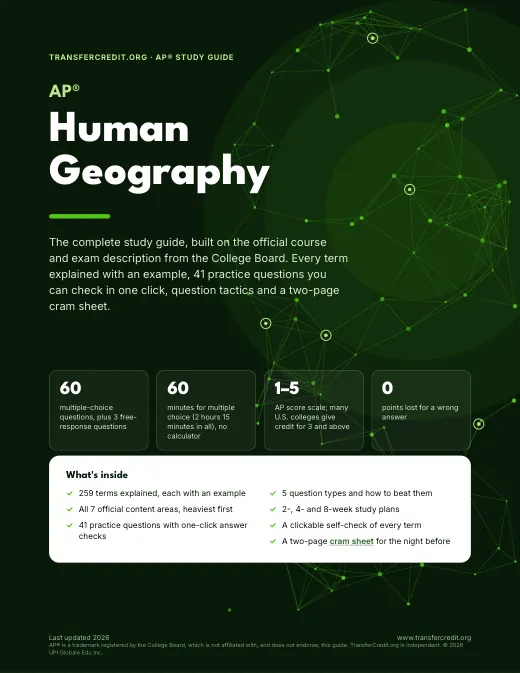
Page 1 of the TransferCredit.org Guide to AP® Human Geography: the cover
Page 1 The cover
Page 6 of the TransferCredit.org Guide to AP® Human Geography: the Chapter 1 opener
Page 6 The Chapter 1 opener
Page 10 of the TransferCredit.org Guide to AP® Human Geography: a chapter quiz
Page 10 A chapter quiz
Page 46 of the TransferCredit.org Guide to AP® Human Geography: the 2-page cram sheet
Page 46 The 2-page cram sheet

What you get for $5

One chapter for each area of the official course and exam description, heaviest topics first.

  • 📘47pages, printable
  • 🧭7chapters
  • 🔑259terms with examples
  • ✍️41practice questions, answers explained
  • ⚠️21exam traps to avoid
  • 📄2page cram sheet

Try 10 free AP® Human Geography questions

Multiple-choice questions taken from the guide's chapter quizzes: 7 areas, heaviest first. About 10 minutes, with every answer explained and a score by area. The exam's free-response questions aren't in this quiz: see how the exam works.

10 questions  
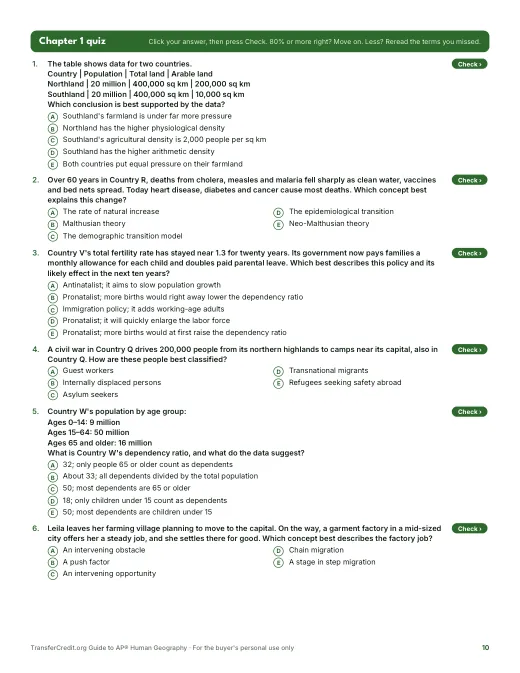
  1. Question 1 · Population and Migration
    The table shows data for two countries.
    Country | Population | Total land | Arable land
    Northland | 20 million | 400,000 sq km | 200,000 sq km
    Southland | 20 million | 400,000 sq km | 10,000 sq km
    Which conclusion is best supported by the data?
    Show the answer

    Answer: E. Southland's farmland is under far more pressure. Both countries have an arithmetic density of 50 people per sq km. But Southland has 2,000 people per sq km of arable land, against Northland's 100. Physiological density shows pressure on food-growing land, and Southland's is 20 times higher.

    The trap: "Southland's agricultural density is 2,000 people per sq km" uses the right number for the wrong measure. 2,000 is the physiological density; agricultural density counts only farmers, and the table gives no farmer data.

  2. Question 2 · Culture
    A new style of running shoe first goes on sale in Country X's three largest cities. Two years later it reaches mid-size cities, and only after four years does it appear in small towns, including towns just outside the big cities. Which type of diffusion does this best show?
    Show the answer

    Answer: D. Hierarchical diffusion. The style moved down the urban hierarchy, from the largest cities to mid-size cities to small towns, skipping nearby small towns at first. That is hierarchical diffusion.

    The trap: Contagious diffusion would reach the small towns next to the big cities early, through nearby contact. Here those towns had to wait their turn in the hierarchy.

  3. Question 3 · Political Geography
    A photograph shows a grassy strip running through the middle of a large city. A double row of paving stones marks its route, and a few concrete wall segments and a watchtower are kept as a memorial. Until a few decades ago, a guarded wall on this line split the city in two. What does the photograph show?
    Show the answer

    Answer: A. A relict boundary. The line no longer divides anything, but traces of it remain in the landscape. A boundary that has stopped functioning yet can still be seen is a relict boundary.

    The trap: "A demilitarized zone" fits the old watchtower, but a demilitarized zone is a working buffer between rivals. This strip is now a memorial inside one city.

  4. Question 4 · Agriculture and Rural Land Use
    A geographer maps farm land use on a flat plain around City Q, the region's only market. Dairy and vegetable farms sit closest, then woodlots, then wheat, then cattle grazing. But a valley 150 miles away, with rare soils and a mild climate, grows costly wine grapes. Why doesn't the valley fit the model?
    Show the answer

    Answer: B. Specialty crops depend on soil and climate, not just distance. Von Thünen explains land use by transport cost from one market on a uniform plain. A specialty crop tied to particular soils and climate earns enough to justify the distance, so it breaks the ring pattern.

    The trap: A crop that spoils fast would be pulled closer to the market, not pushed farther away. That is why dairy sits in the inner ring.

  5. Question 5 · Cities and Urban Land Use
    City F has about 2 million people. It hosts a major stock exchange, the headquarters of several global banks, and direct flights to every inhabited continent. How is City F best classified?
    Show the answer

    Answer: C. A world city. A world city is defined by its global economic and cultural influence, not its size. Global finance, company headquarters and worldwide flight links put City F near the top of the global urban hierarchy.

    The trap: "A megacity" is tempting because many world cities are huge, but a megacity needs more than 10 million people. City F has about 2 million.

  6. Question 6 · Industry and Development
    A table compares two countries. Country P: GNI per capita $30,000; life expectancy 66 years; average years of schooling 5. Country Q: GNI per capita $12,000; life expectancy 78 years; average years of schooling 11. Why would a geographer compare them with the HDI rather than GNI per capita alone?
    Show the answer

    Answer: E. Income alone ranks P well ahead, but Q does better on health and education. GNI per capita alone puts P far ahead, $30,000 to $12,000. The HDI also counts health and education, where Q leads, so it gives a fuller picture of development.

    The trap: GNI per capita does not include life expectancy or schooling. It measures income only, which is why the HDI adds them.

  7. Question 7 · Thinking Geographically
    A choropleth map shades each country of the world by the percent of its households with internet access. One large country falls in the lowest category, yet its capital region has very high access. What limitation of the map does this reveal?
    Show the answer

    Answer: A. It hides variation inside each country. A choropleth gives each country one shade, as if the value were the same everywhere inside it. The capital's high access is hidden inside the country's low national rate.

    The trap: Distorted shapes near the poles come from some map projections, such as the Mercator, not from shading areas by a rate.

  8. Question 8 · Population and Migration
    Over 60 years in Country R, deaths from cholera, measles and malaria fell sharply as clean water, vaccines and bed nets spread. Today heart disease, diabetes and cancer cause most deaths. Which concept best explains this change?
    Show the answer

    Answer: C. The epidemiological transition. The epidemiological transition describes how the main causes of death shift as a country develops, from infectious diseases toward chronic diseases such as heart disease and cancer.

    The trap: The demographic transition model is tempting because death rates fall in it too, but it tracks birth and death rates, not which diseases cause deaths.

  9. Question 9 · Culture
    A table shows where the followers of Religion Y live: its hearth country, 93%; three overseas cities where migrant laborers from the hearth settled a century ago, 6%; the rest of the world, 1%. Religion Y sends out no missionaries. Which description best fits Religion Y?
    Show the answer

    Answer: B. An ethnic religion that spread mainly by relocation diffusion. Almost all followers live in the hearth country, the religion seeks no converts, and the only clusters abroad formed where its people moved. That fits an ethnic religion spread by relocation diffusion.

    The trap: A universalizing religion spread by contagious diffusion would seek converts and have followers in many places, not 93% in the hearth country.

  10. Question 10 · Political Geography
    A state is divided into five voting districts of 100 voters each. The table shows how each district voted.
    District | Party A | Party B
    1 | 60 | 40
    2 | 60 | 40
    3 | 60 | 40
    4 | 10 | 90
    5 | 10 | 90
    Which statement best explains the results?
    Show the answer

    Answer: D. Packing Party B voters into two districts lets Party A win most seats. Statewide, Party A has 200 of 500 votes (40%), yet it wins 3 of 5 seats. Party B's voters are packed into districts 4 and 5, where most of its votes are wasted. Drawing lines this way is gerrymandering, and it is why results at the district scale differ from the statewide vote.

    The trap: "Party A won most seats because it won most votes statewide" fails the arithmetic: add the columns and Party A has 200 votes to Party B's 300.

The AP® Human Geography exam at a glance

The AP® Human Geography exam is from the College Board. It has 60 multiple-choice questions, plus 3 free-response questions. You get 60 minutes for multiple choice (2 hours 15 minutes in all), no calculator. The score scale is 1–5 (AP® score scale; many U.S. colleges give credit for 3 and above). The guide has 7 chapters, one for each area of the official course and exam description; the heaviest is Population and Migration Patterns and Processes at 12–17%.

Questions
60multiple-choice questions, plus 3 free-response questions
Time
60 minfor the 60 multiple-choice questions, about 60 seconds a question
Score
1–5AP® score scale; many U.S. colleges give credit for 3 and above
Fee
$99per exam in the U.S. and Canada in 2026-27; your school may charge more
Calculator
Nonot allowed
Wrong answers
No penaltya wrong answer costs nothing
  • Section I has 60 multiple-choice questions in 60 minutes (50% of your score). Section II has 3 free-response questions in 75 minutes (50%), worth 7 points each.
  • Free-response question 1 has no stimulus, question 2 has one (data, an image or a map) and question 3 has two. Each sets a real geographic scenario and asks you to describe, explain and apply concepts.
  • About 30–40% of the multiple-choice questions use a stimulus: a map, table, chart, graph, image, infographic or landscape. Some questions come in sets on the same stimulus.
  • The exam is fully digital: you answer every question in the Bluebook testing app. No calculator is allowed.
  • Your multiple-choice score is the number of questions you answer correctly, so a wrong answer costs nothing.
  • Unit 1 is 8–10% of the multiple-choice section; each of Units 2–7 is 12–17%.

Source: official AP® Human Geography page and the official course and exam description. Last updated 2026.

What the exam covers

7 chapters, heaviest first, with each area's official weight. The guide's chapters follow this order.

  1. Population and Migration Patterns and Processes12–17% · ~7–10 Q
  2. Cultural Patterns and Processes12–17% · ~7–10 Q
  3. Political Patterns and Processes12–17% · ~7–10 Q
  4. Agriculture and Rural Land-Use Patterns and Processes12–17% · ~7–10 Q
  5. Cities and Urban Land-Use Patterns and Processes12–17% · ~7–10 Q
  6. Industrial and Economic Development Patterns and Processes12–17% · ~7–10 Q
  7. Thinking Geographically8–10% · ~5–6 Q

Where to start: the 5 heaviest areas (marked in the map) carry about 44 of the 60 questions. The guide puts them first, so working front to back covers the most points earliest.

AP® Human Geography study guide by area

The 2 heaviest areas are open to read now. The full guide has a chapter for every area, each with all its terms, a quiz and an answer key.

2 of 7 chapters open  ·  in the guide's order
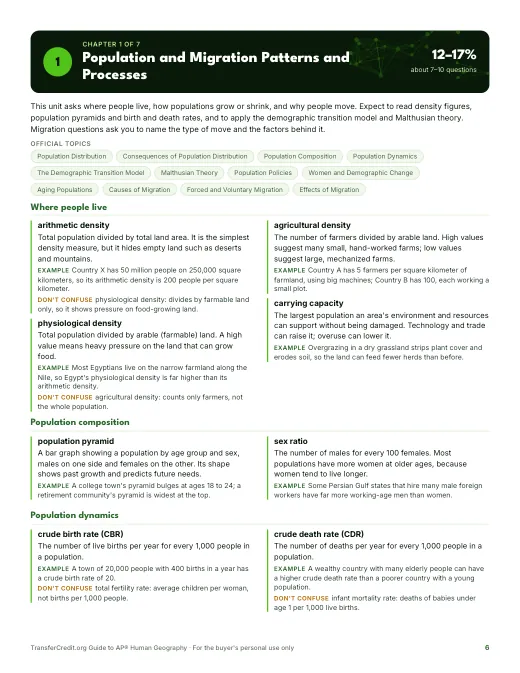
12–17% · about 7–10 questions · free preview Population and Migration Patterns and Processes Chapter 1 of the guide

This unit asks where people live, how populations grow or shrink, and why people move. Expect to read density figures, population pyramids and birth and death rates, and to apply the demographic transition model and Malthusian theory. Migration questions ask you to name the type of move and the factors behind it.

Key terms, with examples

arithmetic density
Total population divided by total land area. It is the simplest density measure, but it hides empty land such as deserts and mountains.
Example: Country X has 50 million people on 250,000 square kilometers, so its arithmetic density is 200 people per square kilometer.
population pyramid
A bar graph showing a population by age group and sex, males on one side and females on the other. Its shape shows past growth and predicts future needs.
Example: A college town's pyramid bulges at ages 18 to 24; a retirement community's pyramid is widest at the top.
crude birth rate (CBR)
The number of live births per year for every 1,000 people in a population.
Example: A town of 20,000 people with 400 births in a year has a crude birth rate of 20.
demographic transition model (DTM)
A model of how birth and death rates change as a country develops. Stage 1: both high. 2: deaths fall. 3: births fall. 4: both low. 5: births below deaths.
Example: Italy now records more deaths than births each year, which fits stage 5.
pronatalist policy
A government policy that encourages people to have more children, for example with cash payments, paid parental leave or cheaper child care.
Example: France has long paid family allowances and offered subsidized day care to support larger families.
Ravenstein's laws of migration
E. G. Ravenstein's 1880s generalizations: most moves are short, long moves head for big cities, every flow has a counterflow, and women move more within countries, men more abroad.
Example: Ravenstein found men more often moved abroad; today women are about half of international migrants, many moving alone for care work.
push factor
A condition that drives people to leave a place. Push factors can be cultural, demographic, economic, environmental or political.
Example: Years of drought that ruin harvests push farm families out of a dry region.
forced migration
Movement that people do not choose, made under threat of violence, persecution, disaster or enslavement.
Example: The Atlantic slave trade forcibly carried millions of Africans to the Americas.
remittances
Money that migrants send back to family in their home country. In some poorer countries, remittances bring in more money than foreign aid.
Example: Wages a Nepali construction worker earns in Qatar pay for his children's schooling back home.
physiological density
Total population divided by arable (farmable) land. A high value means heavy pressure on the land that can grow food.
Example: Most Egyptians live on the narrow farmland along the Nile, so Egypt's physiological density is far higher than its arithmetic density.
sex ratio
The number of males for every 100 females. Most populations have more women at older ages, because women tend to live longer.
Example: Some Persian Gulf states that hire many male foreign workers have far more working-age men than women.
crude death rate (CDR)
The number of deaths per year for every 1,000 people in a population.
Example: A wealthy country with many elderly people can have a higher crude death rate than a poorer country with a young population.

What this area covers

Where people livePopulation compositionPopulation dynamicsTheories of population changePopulation policiesWomen, aging and population changeWhy people moveTypes of migrationEffects of migration

How the exam asks it

Most questions give a short scenario, a small table of rates or a description of a population pyramid and ask which concept, model or outcome fits. For density data, check what is being divided by what before you compare places. For migration, ask two questions: was the move forced or chosen, and did it cross a border? Effects questions cover both ends of a move: migration changes the economy (workers, remittances), politics (immigration debates) and culture (new foods, languages and faiths). Distribution questions may also ask how spread-out or crowded populations affect services such as medical care.

Common traps

Trap 1. The rate of natural increase leaves out migration. A country whose deaths outnumber births can still grow if enough immigrants arrive.

Trap 2. Refugees have crossed an international border; internally displaced persons have not. Asylum seekers have crossed one but are still waiting for a decision on their claim.

Trap 3. Don't treat Malthus as proven. Critics note that farm technology and trade have let world food output grow faster than population since he wrote.

Memory trick

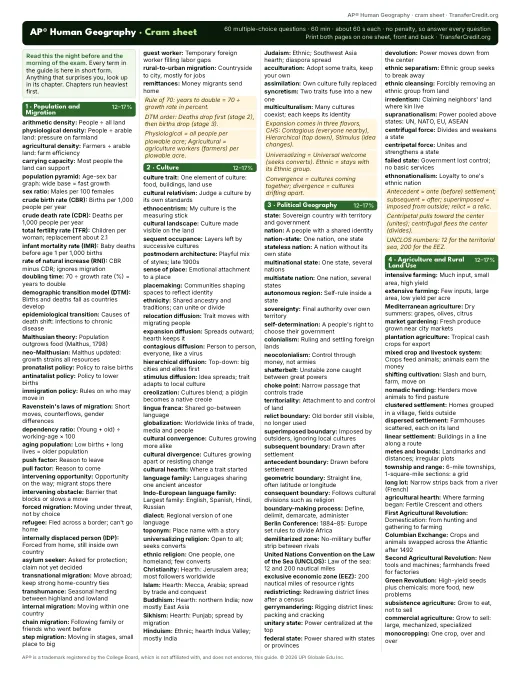
Rule of 70: years to double = 70 ÷ growth rate in percent.

DTM order: Deaths drop first (stage 2), then births drop (stage 3).

12–17% · about 7–10 questions · free preview Cultural Patterns and Processes Chapter 2 of the guide

Unit 3 is about culture: what it is, how it shows on the landscape and how it spreads from place to place. The biggest topics are the types of diffusion and the spread of languages and religions. Expect described landscape photos and short scenarios that ask you to name a type of diffusion or one of its effects.

Key terms, with examples

culture trait
One element of a culture, such as a food, building style or land use. Culture is the shared practices, technologies, attitudes and behaviors a society passes on.
Example: Eating with chopsticks, or building thick-walled adobe homes in the U.S. Southwest.
cultural landscape
The visible imprint of a culture on the land: buildings, farms, signs, religious sites and land-use patterns, layered on physical features.
Example: In San Francisco's Chinatown, an ethnic neighborhood, Chinese-language signs, a gateway arch and temples shape the street scene.
relocation diffusion
The spread of a culture trait when people move and carry it with them to a new place.
Example: Irish immigrants brought St. Patrick's Day parades to Boston and New York.
creolization
The blending of cultures into a new form, especially when a pidgin, a simple trade language, becomes a group's native language, called a creole.
Example: Haitian Creole grew from French mixed with West African languages and is now the first language of most Haitians.
cultural hearth
The place where a culture trait, idea or innovation began and from which it spread. Languages, religions, ethnic cultures and gender roles all have hearths.
Example: Jazz began in New Orleans and spread from there to Chicago, New York and the world.
universalizing religion
A religion that seeks to appeal to all people, wherever they live, and actively seeks converts. It spreads by both expansion and relocation diffusion.
Example: Members of a faith travel abroad to share its teachings and welcome converts from any ethnic group.
acculturation
The process in which a group adopts some traits of another, usually dominant, culture while keeping much of its own.
Example: Korean American families serve turkey at Thanksgiving while still celebrating Korean holidays with Korean foods.
cultural relativism
Judging a culture by its own standards and values, not by those of your own culture.
Example: A visitor to Japan learns why people take off their shoes indoors instead of mocking the custom.
sequent occupance
The idea that each group that occupies a place leaves its own cultural imprint, so the landscape shows layers from successive societies.
Example: In Mexico City's historic center, the ruins of an Aztec temple sit beside a cathedral built by Spanish colonizers.
expansion diffusion
The spread of a trait outward from its hearth through a population, while it stays strong where it began. Its types are contagious, hierarchical and stimulus.
Example: A slang word from one city spreads to nearby towns and stays popular back home.
lingua franca
A common language used for communication among people who speak different native languages, often for trade, government or diplomacy.
Example: English is used worldwide in business and science, and pilots and air traffic controllers use it on international flights.
language family
A group of languages descended from one ancestral language spoken before recorded history.
Example: The Sino-Tibetan family includes Mandarin; the Afro-Asiatic family includes Arabic and Hebrew.

What this area covers

What culture isLandscapes, identity and placeTypes of diffusionCauses of diffusion, past and presentLanguageReligionEffects of diffusion

How the exam asks it

Most questions describe a scenario or a landscape photo and ask which type of diffusion, which effect of diffusion or which concept it shows. Decide first whether people moved (relocation) or only the idea spread (expansion), then pick the kind of expansion. Religion questions ask how a religion spread from its hearth and why, using the universalizing and ethnic types. Other questions ask how colonialism, trade, the internet and time-space convergence changed languages and cultures, sometimes comparing what happens at the global and local scales.

Common traps

Trap 1. Relocation diffusion needs people to move. If a trait spreads while people stay where they are, through contact or media, it is expansion diffusion.

Trap 2. Hierarchical diffusion skips places: a big city far away can get a trend before a small town right next to the hearth.

Trap 3. Acculturation keeps much of the group's own culture; assimilation replaces it. Syncretism makes something new from both.

Memory trick

Expansion comes in three flavors, CHS: Contagious (everyone nearby), Hierarchical (top down), Stimulus (idea changes).

Universalizing = Universal welcome (seeks converts). Ethnic = stays with its Ethnic group.

How AP® Human Geography questions are written

The exam has 60 multiple-choice questions, plus 3 free-response questions. The guide sorts the questions into 5 types; spot the type and you'll know what the question wants before you read the choices.

Type 1

Name the concept or model in a scenario

A short real-world situation, then "Which concept best explains..." or "This is an example of...", with five named concepts as choices. This is the most common type.

  • Name the concept yourself from the key detail before you read the choices.
  • If two choices are look-alikes, such as relocation and expansion diffusion, find the one detail in the scenario that separates them.
  • Cross out choices that need a fact the scenario never gives.
Type 2

Read a map or data table

A map, table, chart or graph (an image on the exam; described in words in this guide), then a question about the pattern, a simple calculation, or what the data can't show.

  • Read the title, key and units first: what is measured, where and when?
  • Put the pattern in your own words (rising, falling, clustered, highest in the north) before you look at the choices.
  • For limits, ask what the data leave out: differences inside each area, uncounted activity or change over time.
Type 3

Scale of analysis

Data or a process at one or more scales (global, regional, national, local), then "Which scale best shows..." or "What does the local map reveal that the national one hides?"

  • Name the scale of each source.
  • Ask what the larger scale averages away and what the smaller scale shows.
  • Choose the answer that explains the difference between scales, not one that calls a source wrong.
Type 4

Strengths and limits of a model

A named model or theory, such as the von Thünen model, the concentric-zone model or Rostow's stages, applied to a real place, then "Which is a limitation..." or "Which observation best supports..."

  • Recall the model's assumptions, such as one center, flat land or one path for every country.
  • A limitation is usually a real case that breaks one of those assumptions.
  • Watch for choices that describe the model correctly but don't answer the question asked.
Type 5

A set of questions on one stimulus

Two or three questions that share one map, table, photo or infographic, each testing a different skill: identify, then explain, then apply or compare.

  • Study the stimulus once, carefully: title, key, units and any trend.
  • Answer each question from the stimulus plus the course concept it points to.
  • Don't let one hard question in the set eat your time; answer the easier ones first.

Test-day habits that add points

  1. Answer every question. There's no penalty for a wrong answer. A blank is always worth zero, so never leave one.
  2. Predict, then look. Name the answer before reading the choices. It protects you from distractors written to sound right.
  3. Eliminate. Cross out choices you know are wrong. Every choice you rule out raises your odds on a guess.
  4. Mark and move on. If a question takes more than a minute, pick your best guess, mark it and come back if time allows.
  5. Watch absolute words. Choices with "always", "never" or "only" are often wrong, because most rules and findings have exceptions. Treat this as a tiebreaker, not a rule.
  6. Change answers for a reason. Switch an answer only when you can say why the new one is better, such as a detail you missed.
  7. The three free-response questions. Section II has 3 free-response questions in 75 minutes (50% of your score), worth 7 points each. Question 1 has no stimulus; question 2 has one stimulus (data, an image or a map); question 3 has two stimuli (data, images and/or maps). Each presents an authentic geographic situation or scenario and asks you to describe, explain and apply geographic concepts, processes or models. At least one asks you to analyze across geographic scales. Follow the task verb: Compare (give similarities and/or differences), Define (give a specific meaning), Describe (give the relevant characteristics), Explain (say how or why, using evidence or reasoning) and Identify (name it, without explaining).

Pacing: 60 questions in 60 minutes, about 60 seconds a question.

AP® Human Geography flashcards

Try the first 8 cards free. Read the term, say the definition out loud, then select the card to check yourself. Arrow keys move between cards.

Free card 1 of 8 (deck total: 259)

How to study for AP® Human Geography: a 5-step plan

Follow the steps, then enter your test date. The planner gives you a dated plan that starts with the heaviest areas and saves the last days for review.

  1. Take the 10 free questionsSee which AP® Human Geography areas you already know.
  2. Study the heaviest areas firstStart with Population and Migration Patterns and Processes, Cultural Patterns and Processes and Political Patterns and Processes, then work down the exam map.
  3. Learn each term with an exampleSay the definition out loud, then check it with the flashcards. A term you can't use in an example isn't learned yet.
  4. Quiz yourself and study the trapsAfter each area, answer its quiz and read why the tempting wrong answer is wrong.
  5. Plan backwards from your exam dateBuild a dated plan, keep the last days for a full review, and read the cram sheet the night before.

How it works

  1. 1Check outSelect Get the guide · $5 and pay on TransferCredit.org's secure checkout.
  2. 2Download the PDFFrom your TransferCredit.org account.
  3. 3Study the heaviest areas firstFollow the 2-, 4- or 8-week plan, then read the cram sheet the night before.

This page or the full guide

Everything on this page is free with no account. The full guide is a PDF you keep.

What's on this page and in the full study guide
Study toolThis pageFull study guide ($5)
ChaptersA preview of 2 of 7All 7
Terms explainedA sample from the open chaptersAll 259, each with an example
Practice questions10 free questions41, with an answer key
Flashcards8 cardsAll 259 terms on the self-check list
Study planDated planner2-, 4- and 8-week plans
Cram sheet—2 pages, for the night before
FormatWeb page47-page PDF, printable

Questions students ask

What's in the full AP® Human Geography study guide?
47 pages: 7 chapters, one for each area of the College Board's official course and exam description, heaviest topics first. 259 terms, each with a plain-English definition and an example, common traps and memory tricks, 41 practice questions with an answer key that explains every answer, question tactics, 2-, 4- and 8-week study plans and a 2-page cram sheet.
How much is the full AP® Human Geography study guide?
The full 47-page PDF is $5. The 10 practice questions on this page are free.
How do I get the full guide?
Select Get the guide · $5 and check out on TransferCredit.org. Then sign in to your TransferCredit.org account to download the PDF.
Can I print the guide or use it on my phone?
Yes. It's a PDF, so it opens on phones, tablets and computers, and printing is allowed. Its tick boxes and answer bubbles work in PDF readers that support forms. Copying and editing are turned off.
Can I try the AP® Human Geography guide before I buy it?
Yes. This page has 10 questions from the guide's own chapter quizzes, a preview of the 2 heaviest areas, 8 flashcards and a study planner. No account needed.
Is this an official AP® study guide?
No. AP® is a trademark registered by the College Board, which is not affiliated with, and does not endorse, this guide. TransferCredit.org is independent. We built the guide from the College Board's official course and exam description, and the exam details were checked against the College Board's published exam information in 2026.
How was this study guide made?
One chapter for each area of the official course and exam description, using its published weights. Each chapter was written, then fact-checked against the official exam information in a separate review. The practice questions are original: none are copied from the College Board's released questions.
How up to date is this AP® Human Geography guide?
Last updated 2026. The exam details were checked against the College Board's published exam information in 2026. Exams change, so confirm the details on the official AP® Human Geography page before you test.
More questions about the AP® Human Geography exam (16)
What is the AP® Human Geography exam?
The AP® Human Geography exam is from the College Board. It has 60 multiple-choice questions, plus 3 free-response questions. You get 60 minutes for multiple choice (2 hours 15 minutes in all), no calculator. The score scale is 1–5 (AP® score scale; many U.S. colleges give credit for 3 and above). The guide has 7 chapters, one for each area of the official course and exam description; the heaviest is Population and Migration Patterns and Processes at 12–17%.
How many questions are on the AP® Human Geography exam, and how long is it?
Section I has 60 multiple-choice questions in 60 minutes (50% of your score). Section II has 3 free-response questions in 75 minutes (50%), worth 7 points each.
How is the AP® Human Geography exam scored?
The score scale is 1–5: AP® score scale; many U.S. colleges give credit for 3 and above. Your multiple-choice score is the number of questions you answer correctly, so a wrong answer costs nothing.
What AP® Human Geography score do I need for college credit?
Many U.S. colleges give credit for 3 and above. Each college sets its own credit policy, so check the one at your college before you count on the credit.
How much does the AP® Human Geography exam cost?
The fee is $99: per exam in the U.S. and Canada in 2026-27; your school may charge more. Fees can change, so check the official page when you register.
Can I use a calculator on the AP® Human Geography exam?
No calculator is allowed.
Is there a penalty for guessing on AP® Human Geography?
No. There's no penalty for a wrong answer. A blank is always worth zero, so never leave one.
What topics are on the AP® Human Geography exam?
7 areas, from the official course and exam description: Population and Migration Patterns and Processes (12–17%); Cultural Patterns and Processes (12–17%); Political Patterns and Processes (12–17%); Agriculture and Rural Land-Use Patterns and Processes (12–17%); Cities and Urban Land-Use Patterns and Processes (12–17%); Industrial and Economic Development Patterns and Processes (12–17%); Thinking Geographically (8–10%).
Which AP® Human Geography topics should I study first?
The 5 heaviest areas (marked in the map) carry about 44 of the 60 questions. The guide puts them first, so working front to back covers the most points earliest.
Is the AP® Human Geography exam hard?
It depends on what you already know. The largest area, Population and Migration Patterns and Processes, is 12–17%, and the smallest, Thinking Geographically, is 8–10%. Try the 10 free questions above to see where you stand in about 10 minutes.
What kinds of questions are on the AP® Human Geography exam?
The exam has 60 multiple-choice questions, plus 3 free-response questions. The guide sorts the questions into 5 types: “Name the concept or model in a scenario”, “Read a map or data table”, “Scale of analysis”, “Strengths and limits of a model” and “A set of questions on one stimulus”. Multiple-choice questions have 5 answer choices. See how each type is written.
What are the free-response questions on the AP® Human Geography exam?
Section II has 3 free-response questions in 75 minutes (50% of your score), worth 7 points each. Question 1 has no stimulus; question 2 has one stimulus (data, an image or a map); question 3 has two stimuli (data, images and/or maps). Each presents an authentic geographic situation or scenario and asks you to describe, explain and apply geographic concepts, processes or models. At least one asks you to analyze across geographic scales. Follow the task verb: Compare (give similarities and/or differences), Define (give a specific meaning), Describe (give the relevant characteristics), Explain (say how or why, using evidence or reasoning) and Identify (name it, without explaining).
How should I pace myself on the AP® Human Geography exam?
60 questions in 60 minutes, about 60 seconds a question. If a question takes more than a minute, pick your best guess, mark it and come back if time allows.
How long should I study for AP® Human Geography?
Take the 10 free questions to see where you stand. The full guide has 2-, 4- and 8-week plans built from the exam weights, and the planner on this page builds a dated plan from your exam date.
How do I know I'm ready for the AP® Human Geography exam?
The guide's readiness checklist: You can explain every term on the checklist without notes. You score 80% or better on every chapter quiz. You can read the cram sheet and nothing on it surprises you. You know the AP® score your college gives credit for, and your exam date.
What should I do the night before?
Read the 2-page cram sheet once, slowly. Check your exam time and room with your AP® coordinator. The whole exam is taken in the Bluebook app. In the morning, skim the traps, then stop studying.

How we built this guide

We built one chapter for each area of the College Board's official course and exam description for AP® Human Geography, using its published weights to order the chapters and size the quizzes. Each chapter was written, then fact-checked against the official exam information in a separate review. The exam details were checked against the College Board's published exam information in 2026.

Sources: official AP® Human Geography page, official course and exam description. Last updated 2026.

AP® is a trademark registered by the College Board, which is not affiliated with, and does not endorse, this guide. TransferCredit.org is independent and not affiliated with the College Board. © 2026 UPI Globale Edu Inc.

Ready for the full AP® Human Geography guide? 47 pages, 259 terms, 41 practice questions and a 2-page cram sheet, $5.

Get the guide · $5

In the full guide

TransferCredit.org Guide to AP® Human Geography

  • All 7 chapters
  • 259 terms with examples
  • 41 practice questions with an answer key
  • A 2-page cram sheet and 2-, 4- and 8-week plans
Get the guide · $5