← All AP® study guides
AP® Study Guide Printable PDF · 49 pages

TransferCredit.org Guide to AP® Psychology

AP® Psychology study guide: a printable PDF built from the College Board's official course and exam description, heaviest topics first.

  • 273 key terms, each with an example
  • 55 practice questions with every answer explained
  • A 2-page cram sheet for the night before
  • 2-, 4- and 8-week study plans built from the exam weights
Not sure yet? Try 10 free questions

Last updated 2026 · exam details checked against the College Board's published exam information in 2026

Look inside the guide

Real pages from the 49-page PDF.

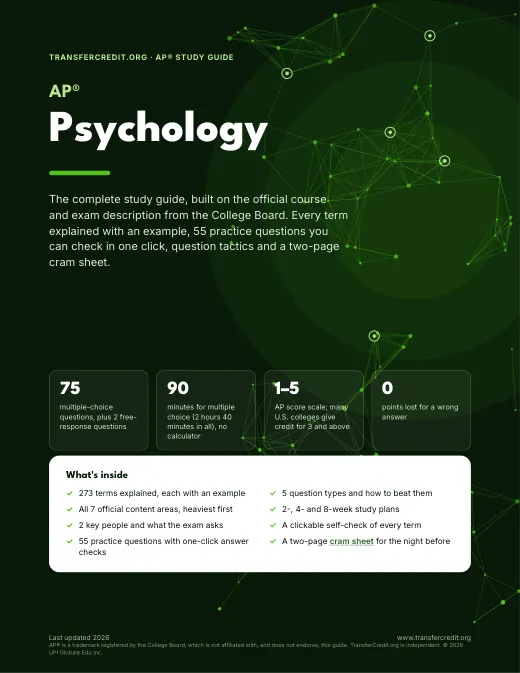
Page 1 of the TransferCredit.org Guide to AP® Psychology: the cover
Page 1 The cover
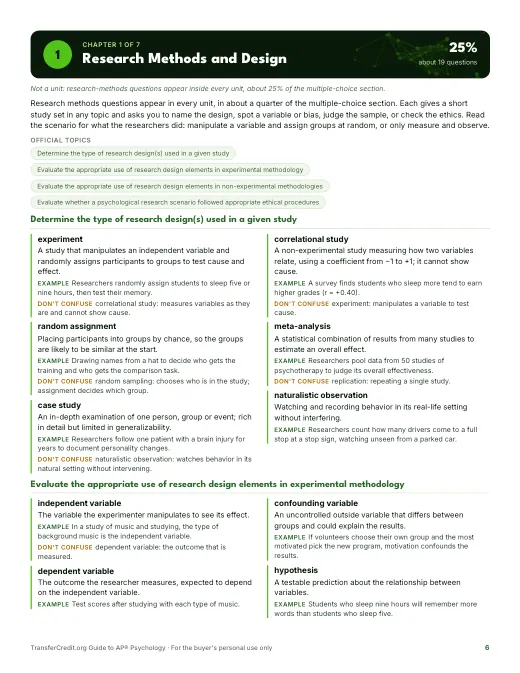
Page 6 of the TransferCredit.org Guide to AP® Psychology: the Chapter 1 opener
Page 6 The Chapter 1 opener
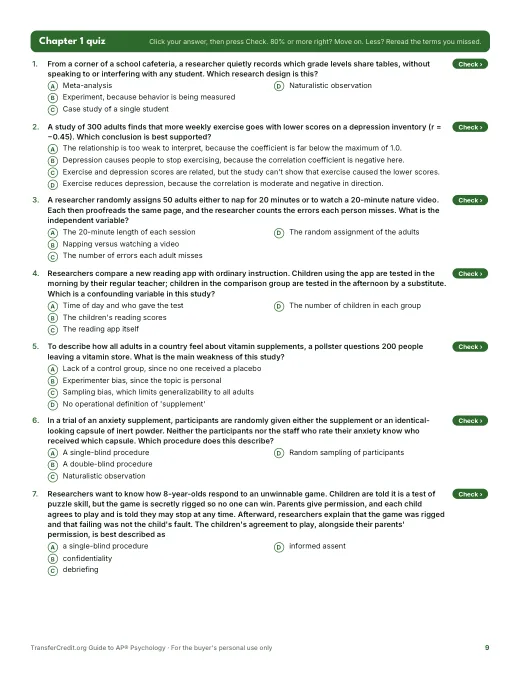
Page 9 of the TransferCredit.org Guide to AP® Psychology: a chapter quiz
Page 9 A chapter quiz
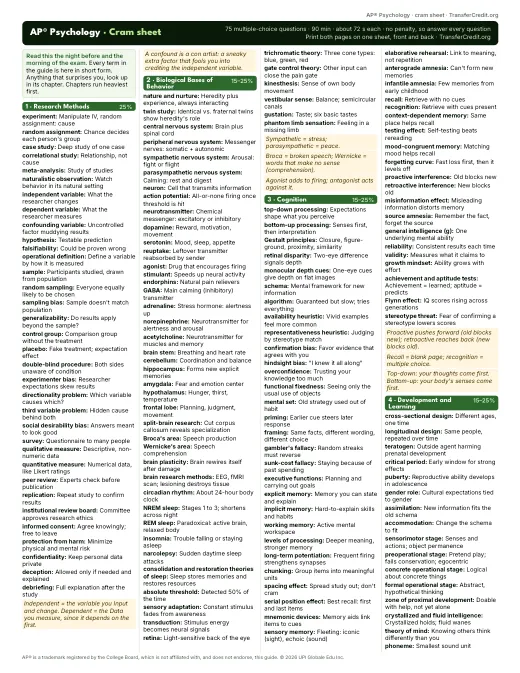
Page 48 of the TransferCredit.org Guide to AP® Psychology: the 2-page cram sheet
Page 48 The 2-page cram sheet

What you get for $5

One chapter for each area of the official course and exam description, heaviest topics first.

  • 📘49pages, printable
  • 🧭7chapters
  • 🔑273terms with examples
  • ✍️55practice questions, answers explained
  • ⚠️21exam traps to avoid
  • 📄2page cram sheet

Try 10 free AP® Psychology questions

Multiple-choice questions taken from the guide's chapter quizzes: 7 areas, heaviest first. About 10 minutes, with every answer explained and a score by area. The exam's free-response questions aren't in this quiz: see how the exam works.

10 questions  
  1. Question 1 · Research Methods
    From a corner of a school cafeteria, a researcher quietly records which grade levels share tables, without speaking to or interfering with any student. Which research design is this?
    Show the answer

    Answer: A. Naturalistic observation. Recording behavior in its real setting without intervening is naturalistic observation.

    The trap: Experiment is wrong: the researcher manipulated no independent variable and did not assign anyone to groups.

  2. Question 2 · Biological Bases of Behavior
    While hiking, Marcus hears a rattle near his foot. His heart pounds, his breathing quickens and his pupils widen. Which part of his nervous system produced these changes?
    Show the answer

    Answer: D. Sympathetic nervous system. Arousing the body for a threat is the job of the sympathetic division of the autonomic system.

    The trap: Parasympathetic is the tempting choice, but it calms the body and slows the heart rate, the opposite of what Marcus experienced.

  3. Question 3 · Cognition
    After seeing several news reports about shark attacks, Priya cancels her beach vacation, though she knows drowning in a pool is far more common. Which concept best explains her decision?
    Show the answer

    Answer: B. Availability heuristic. Vivid, easily recalled news stories make shark attacks seem likely. Judging likelihood by how readily examples come to mind is the availability heuristic.

    The trap: Representativeness heuristic is tempting because it is also a shortcut, but it depends on matching a stereotype or prototype, not on how easily examples come to mind.

  4. Question 4 · Development and Learning
    A psychologist studying how empathy changes with age tests 60 children each at ages 5, 8 and 11 during a single month. Which statement about this design is accurate?
    Show the answer

    Answer: C. It is cross-sectional, so group differences might reflect more than age, such as differing experiences.. Different age groups were tested at one time, which is a cross-sectional design. The groups may differ in more than age, so the design can't separate age from other differences.

    The trap: Longitudinal is tempting because the ages span six years, but a longitudinal design follows the same children over time.

  5. Question 5 · Social Psychology and Personality
    A shopper watches a cashier snap at a customer and decides the cashier is simply a rude person. She does not consider that the cashier has worked a ten-hour shift and faced an hour-long line. The shopper's judgment is best described as
    Show the answer

    Answer: B. the fundamental attribution error. She explains the cashier's behavior by personality and ignores the circumstances, which is the fundamental attribution error.

    The trap: A situational attribution is the opposite of her judgment: she blamed the cashier's disposition, not the circumstances.

  6. Question 6 · Mental and Physical Health
    Two weeks before moving to a new city, Jamal makes a checklist of tasks, hires movers and schedules utility transfers. Which kind of coping is he using?
    Show the answer

    Answer: A. Problem-focused coping. Jamal treats the stress as a problem and works on solutions, which is problem-focused coping.

    The trap: Emotion-focused coping is wrong: it would involve managing his feelings, for example with deep breathing, rather than tackling the tasks.

  7. Question 7 · Data Interpretation
    Eight participants recorded the number of minutes they took to fall asleep: 10, 12, 12, 15, 18, 20, 25 and 60. Which measure best describes a typical time, given the extreme value of 60?
    Show the answer

    Answer: C. The median, 16.5 minutes. The ordered scores have a middle of 15 and 18, so the median is 16.5. The mean (172 ÷ 8 = 21.5) is pulled upward by the outlier of 60, so the median describes the typical time better.

    The trap: The mean is the tempting choice, but it is distorted by the single extreme score of 60.

  8. Question 8 · Research Methods
    A study of 300 adults finds that more weekly exercise goes with lower scores on a depression inventory (r = −0.45). Which conclusion is best supported?
    Show the answer

    Answer: D. Exercise and depression scores are related, but the study can't show that exercise caused the lower scores.. A correlation shows a relationship only. Without manipulating exercise and randomly assigning participants, the study can't show which variable, if either, causes the other.

    The trap: The claim that exercise reduces depression ignores the directionality and third variable problems; a correlation, however strong, doesn't show cause.

  9. Question 9 · Biological Bases of Behavior
    Researchers measured shyness in 60 adopted teenagers, their biological parents and their adoptive parents. The teens' scores correlated +.40 with their biological parents' scores and +.05 with their adoptive parents' scores. Which conclusion is best supported?
    Show the answer

    Answer: B. Heredity appears to play a larger role in shyness than the adoptive home does. The teens resembled the biological parents who did not raise them (+.40) far more than the adoptive parents who did (+.05), which points to a hereditary influence. The design is correlational, so it shows a link, not proof of cause.

    The trap: The heredity-alone choice overstates the data: +.40 is a moderate correlation, so other influences clearly matter too.

  10. Question 10 · Cognition
    A researcher randomly assigns 60 volunteers to learn a word list in one of two ways: repeating the words silently, or making up a sentence about each word's meaning. A recall test follows, and the sentence group remembers more words. What is the independent variable?
    Show the answer

    Answer: D. How participants studied the words. The independent variable is the factor the researcher manipulates: here, the study method.

    The trap: The number of words recalled is the dependent variable, the outcome that is measured, not the factor manipulated.

The AP® Psychology exam at a glance

The AP® Psychology exam is from the College Board. It has 75 multiple-choice questions, plus 2 free-response questions. You get 90 minutes for multiple choice (2 hours 40 minutes in all), no calculator. The score scale is 1–5 (AP® score scale; many U.S. colleges give credit for 3 and above). The guide has 7 chapters, one for each area of the official course and exam description; its 5 units carry the same weight (15–25% each).

Questions
75multiple-choice questions, plus 2 free-response questions
Time
90 minfor the 75 multiple-choice questions, about 72 seconds a question
Score
1–5AP® score scale; many U.S. colleges give credit for 3 and above
Fee
$99per exam in the U.S. and Canada in 2026-27; your school may charge more
Calculator
Nonot allowed
Wrong answers
No penaltya wrong answer costs nothing
  • Section I has 75 multiple-choice questions in 90 minutes (66.7% of your score). Section II has 2 free-response questions in 70 minutes (33.3%).
  • The free-response questions are an Article Analysis Question (one summarized study, 25 minutes including 10 minutes of reading) and an Evidence-Based Question (three summarized studies, 45 minutes including 15 minutes of reading).
  • The exam is fully digital: you answer every question in the Bluebook testing app. No calculator is allowed.
  • Your multiple-choice score is the number of questions you answer correctly, so a wrong answer costs nothing.
  • Each of the five units is 15–25% of the multiple-choice section. Research methods (about 25%) and data interpretation (about 10%) are skills tested inside every unit.

Source: official AP® Psychology page and the official course and exam description. Last updated 2026.

What the exam covers

7 chapters, heaviest first, with each area's official weight. The guide's chapters follow this order.

  1. Research Methods and Design *25% · ~19 Q
  2. Biological Bases of Behavior15–25% · ~11–19 Q
  3. Cognition15–25% · ~11–19 Q
  4. Development and Learning15–25% · ~11–19 Q
  5. Social Psychology and Personality15–25% · ~11–19 Q
  6. Mental and Physical Health15–25% · ~11–19 Q
  7. Data Interpretation *10% · ~8 Q

* Not units: skills tested inside every unit. Research Methods and Design: research-methods questions appear inside every unit, about 25% of the multiple-choice section. Data Interpretation: data questions appear inside every unit, about 10% of the multiple-choice section. These weights are a share of the same multiple-choice questions, so the weights add up to more than 100%.

Where to start: all 5 units carry the same weight (15–25% each), so give each one equal time. Start with the skills chapters marked *: they come up inside every unit.

AP® Psychology study guide by area

The 2 heaviest areas are open to read now. The full guide has a chapter for every area, each with all its terms, a quiz and an answer key.

2 of 7 chapters open  ·  in the guide's order
15–25% · about 11–19 questions · free preview Biological Bases of Behavior Chapter 2 of the guide

Biological Bases of Behavior explains how the body and brain produce behavior and mental processes. Expect questions that name a structure, chemical or drug from a short scenario, plus questions on sleep and the senses. Know what each part does, and be ready to read a small study about heredity or the brain.

Key terms, with examples

nature and nurture
Nature is inherited, predisposed characteristics. Nurture is external experience, such as family and education. The two interact to shape behavior and mental processes.
Example: A child's musical talent may reflect musical parents (nature) plus years of lessons and encouragement at home (nurture).
central nervous system
The brain and spinal cord, which interact with all processes in the body.
Example: A signal from a touched fingertip travels up the spinal cord to the brain, which decides how to respond.
neuron
A neural cell that transmits information. Dendrites receive messages and the axon sends them on.
Example: In a reflex arc, a sensory neuron, an interneuron and a motor neuron pull your hand from a hot pan.
brain stem
The structure at the base of the brain, including the medulla, that controls basic functions such as breathing and heart rate.
Example: Damage to the medulla can stop breathing even when the rest of the brain is intact.
circadian rhythm
A cycle of about 24 hours, such as the sleep/wake cycle. Jet lag and shift work disrupt it.
Example: After flying across several time zones, a traveler feels sleepy at noon and wide awake at midnight.
absolute threshold
The minimum stimulus energy needed to detect a stimulus at least 50% of the time.
Example: The faintest scent of perfume a volunteer notices on half of the test trials marks her absolute threshold for it.
twin study
Research comparing identical and fraternal twins to estimate how much heredity affects a trait. It is non-experimental, so it shows correlation, not cause.
Example: If identical twins share a trait far more often than fraternal twins, heredity probably contributes to it.
peripheral nervous system
Nerves relaying messages between the central nervous system and the rest of the body. It includes the somatic (voluntary) and autonomic (involuntary) systems.
Example: Waving to a friend uses somatic nerves; your racing heart on seeing them uses autonomic nerves.
action potential
The brief electrical signal a neuron fires when depolarization from resting potential reaches threshold. It is all-or-none, followed by a refractory period.
Example: Stepping on a tack depolarizes sensory neurons in your foot past threshold, and signals race along their axons.
cerebellum
The structure that coordinates muscle movement and balance and supports some procedural learning.
Example: After cerebellar damage, a pianist's movements turn clumsy and she can't walk a straight line.
NREM sleep
Sleep Stages 1 through 3, identified by EEG patterns, which shortens across the night. Hypnagogic sensations occur as Stage 1 begins.
Example: Drifting off, you suddenly feel as if you are falling: a hypnagogic sensation of initial Stage 1.
sensory adaptation
Diminished sensitivity to a constant, unchanging stimulus over time.
Example: After a few minutes, you no longer notice your watch on your wrist.

What this area covers

Heredity and environmentParts of the nervous systemNeurons and neural firingBrain structuresSleep and sleep disordersSensation

How the exam asks it

Most questions describe a person or a brief study and ask which structure, chemical, drug or process fits. Match the described behavior to its function: speech trouble points to Broca's or Wernicke's area, a racing heart to the sympathetic system, a jump in firing to an agonist. Some questions give a small data set about twins or adopted children, a brain injury or a hearing test and ask what the data support.

Common traps

Trap 1. A twin study cannot prove heredity causes a trait. It is non-experimental, so it shows a correlation only.

Trap 2. Neural firing is all-or-none. A stronger stimulus makes a neuron fire more often, not with a bigger signal.

Trap 3. Sensation is not perception. Thresholds and transduction belong to sensation; interpreting meaning is perception.

Memory trick

Sympathetic = stress; parasympathetic = peace.

Broca = broken speech; Wernicke = words that make no sense (comprehension).

15–25% · about 11–19 questions · free preview Cognition Chapter 3 of the guide

Cognition covers how we perceive, think, remember and measure intelligence. Memory is the biggest piece: expect scenarios that ask which type of memory, encoding strategy, retrieval cue or kind of forgetting is at work. Many questions also ask you to spot a thinking shortcut or bias, or to judge a test's reliability and validity.

Key terms, with examples

top-down processing
Perceiving by using prior knowledge, expectations, schemas and perceptual sets to interpret sensory input.
Example: Reading a sign with a smudged letter as a normal word because you expect that word.
schema
A mental framework for organizing and interpreting information. People form and modify schemas as they learn.
Example: A toddler's "dog" schema leads her to call a cow "doggy" at first.
explicit memory
Memory you can consciously recall and describe to others, including episodic (events) and semantic (facts) memory.
Example: Describing your last birthday party (episodic) or naming a country's capital (semantic).
chunking
Grouping information into meaningful units, categories or hierarchies to improve encoding.
Example: Remembering the number 5558675309 as 555, 867 and 5309.
sensory memory
Very brief storage of sensory input before attention: iconic memory for sights and echoic memory for sounds.
Example: A waved sparkler leaves a brief trail of light (iconic); you can replay a friend's last words though you weren't listening (echoic).
recall
Retrieving information from memory without cues, as on a fill-in-the-blank test.
Example: Writing the names of the planets from memory on a blank page.
forgetting curve
A graph showing that forgetting is rapid soon after learning and then levels off over time.
Example: Most of a lecture's details fade within days, but the loss slows over the following weeks.
general intelligence (g)
The idea of one underlying mental ability behind performance on many cognitive tasks. Researchers debate whether intelligence is g or multiple abilities.
Example: A student who scores high on vocabulary tests also tends to do well on math and spatial tests.
bottom-up processing
Perception that starts with raw sensory information from the environment and builds up to a recognized whole.
Example: Seeing an unfamiliar shape in the dark, you notice lines and edges first before guessing what it is.
algorithm
A step-by-step method that tries every possible solution until the correct one is found.
Example: Trying every three-digit lock combination, starting at 000, until the lock opens.
implicit memory
Memory that shows in performance and is hard to explain, such as procedural memory for skills.
Example: Riding a bike after years away, though you could not explain how you balance.
spacing effect
Better encoding and consolidation when study is distributed over time than when it is crammed all at once (massed practice).
Example: Practicing chemistry problems every other day for a month builds stronger memory than one long weekend session.

What this area covers

PerceptionThinking and decision-makingTypes and models of memoryEncodingStorageRetrievalForgetting and memory errorsIntelligence and achievement

How the exam asks it

Most questions describe a person, a classroom or a short study and ask which concept fits. Name the memory stage or process first: is it encoding, storage or retrieval? For thinking questions, decide whether the person used a shortcut (heuristic) or a bias. Test questions usually turn on one word: consistency means reliability, measuring the right thing means validity.

Common traps

Trap 1. Reliable is not the same as valid. A test can give the same scores every time (reliable) yet measure the wrong thing (not valid).

Trap 2. Anterograde and retrograde are easy to swap. Anterograde blocks new memories; retrograde loses older ones.

Trap 3. Cramming feels productive, but spaced (distributed) practice produces stronger long-term memory. Don't choose massed practice.

Memory trick

Proactive pushes forward (old blocks new); retroactive reaches back (new blocks old).

Recall = blank page; recognition = multiple choice.

How AP® Psychology questions are written

The exam has 75 multiple-choice questions, plus 2 free-response questions. The guide sorts the questions into 5 types; spot the type and you'll know what the question wants before you read the choices.

Type 1

Name the concept in a scenario

A short story about a person or group, then "which concept best explains..." with four named concepts as choices.

  • Skip the choices and name the concept yourself from the key behavior in the story.
  • Find your concept among the choices. If two look alike, find the one detail that separates them (direct order vs. unspoken norm, old blocking new vs. new blocking old).
  • Cross out choices that need a detail the story never gives.
Type 2

Research design and variables

A short study description, then a question about its design, independent or dependent variable, a confound, or what the researchers should have done.

  • Ask whether the researchers manipulated something and randomly assigned people to groups. Both yes means experiment; otherwise non-experimental.
  • In an experiment, the independent variable is what the researchers changed and the dependent variable is what they measured.
  • For flaws, check sampling, random assignment, placebo and blinding.
Type 3

Calculate from a small data set

A short list or one-line table of scores, then a mean, median, mode, range or percentile rank. No calculator is allowed.

  • Put the scores in order first.
  • Do the arithmetic by hand; the numbers are small. Median with an even count is the mean of the two middle scores.
  • Check whether an extreme score pulls the mean away from the median.
Type 4

Interpret a table, graph or statistic

A described graph or table, then a question about the trend, correlation, effect size or statistical significance.

  • Name the two variables and which way they move.
  • A correlation shows association only, never cause, and its sign shows direction while its size shows strength.
  • Separate significance (chance is unlikely) from effect size (how big the difference is).
Type 5

Evaluate a study (sample, ethics, conclusions)

Often set-based: two or three questions on one study, asking about generalizability, bias, ethical procedures or what conclusion the results allow.

  • Read the study once, noting who the participants were, how they were chosen and assigned, and what was measured.
  • Match each question to the design element it targets: sample for generalizability, consent and debriefing for ethics, random assignment for cause.
  • Choose the conclusion the design allows, not the one that sounds most interesting.

Test-day habits that add points

  1. Answer every question. There's no penalty for a wrong answer. A blank is always worth zero, so never leave one.
  2. Predict, then look. Name the answer before reading the choices. It protects you from distractors written to sound right.
  3. Eliminate. Cross out choices you know are wrong. Every choice you rule out raises your odds on a guess.
  4. Mark and move on. If a question takes more than a minute, pick your best guess, mark it and come back if time allows.
  5. Watch absolute words. Choices with "always", "never" or "only" are often wrong, because most rules and findings have exceptions. Treat this as a tiebreaker, not a rule.
  6. Change answers for a reason. Switch an answer only when you can say why the new one is better, such as a detail you missed.
  7. The two free-response questions. Section II has two free-response questions in 70 minutes (33.3% of your score). The Article Analysis Question gives you one summarized peer-reviewed source: 25 minutes including a 10-minute reading period, up to 7 points over 6 parts (research method, research variable, statistic interpretation, ethical guideline, generalizability, and argumentation and application). The Evidence-Based Question gives three summarized sources: 45 minutes including a 15-minute reading period, up to 7 points over 3 parts (a claim, 2 pieces of evidence from the sources, and reasoning that applies AP® Psychology content).

Pacing: 75 questions in 90 minutes, about 72 seconds a question.

AP® Psychology flashcards

Try the first 8 cards free. Read the term, say the definition out loud, then select the card to check yourself. Arrow keys move between cards.

Free card 1 of 8 (deck total: 273)

How to study for AP® Psychology: a 5-step plan

Follow the steps, then enter your test date. The planner gives you a dated plan that starts with the heaviest areas and saves the last days for review.

  1. Take the 10 free questionsSee which AP® Psychology areas you already know.
  2. Study the heaviest areas firstStart with Biological Bases of Behavior, Cognition and Development and Learning, then work down the exam map.
  3. Learn each term with an exampleSay the definition out loud, then check it with the flashcards. A term you can't use in an example isn't learned yet.
  4. Quiz yourself and study the trapsAfter each area, answer its quiz and read why the tempting wrong answer is wrong.
  5. Plan backwards from your exam dateBuild a dated plan, keep the last days for a full review, and read the cram sheet the night before.

How it works

  1. 1Check outSelect Get the guide · $5 and pay on TransferCredit.org's secure checkout.
  2. 2Download the PDFFrom your TransferCredit.org account.
  3. 3Study the heaviest areas firstFollow the 2-, 4- or 8-week plan, then read the cram sheet the night before.

This page or the full guide

Everything on this page is free with no account. The full guide is a PDF you keep.

What's on this page and in the full study guide
Study toolThis pageFull study guide ($5)
ChaptersA preview of 2 of 7All 7
Terms explainedA sample from the open chaptersAll 273, each with an example
Practice questions10 free questions55, with an answer key
Flashcards8 cardsAll 273 terms on the self-check list
Study planDated planner2-, 4- and 8-week plans
Cram sheet—2 pages, for the night before
FormatWeb page49-page PDF, printable

Questions students ask

What's in the full AP® Psychology study guide?
49 pages: 7 chapters, one for each area of the College Board's official course and exam description, heaviest topics first. 273 terms, each with a plain-English definition and an example, 2 key people, common traps and memory tricks, 55 practice questions with an answer key that explains every answer, question tactics, 2-, 4- and 8-week study plans and a 2-page cram sheet.
How much is the full AP® Psychology study guide?
The full 49-page PDF is $5. The 10 practice questions on this page are free.
How do I get the full guide?
Select Get the guide · $5 and check out on TransferCredit.org. Then sign in to your TransferCredit.org account to download the PDF.
Can I print the guide or use it on my phone?
Yes. It's a PDF, so it opens on phones, tablets and computers, and printing is allowed. Its tick boxes and answer bubbles work in PDF readers that support forms. Copying and editing are turned off.
Can I try the AP® Psychology guide before I buy it?
Yes. This page has 10 questions from the guide's own chapter quizzes, a preview of the 2 heaviest areas, 8 flashcards and a study planner. No account needed.
Is this an official AP® study guide?
No. AP® is a trademark registered by the College Board, which is not affiliated with, and does not endorse, this guide. TransferCredit.org is independent. We built the guide from the College Board's official course and exam description, and the exam details were checked against the College Board's published exam information in 2026.
How was this study guide made?
One chapter for each area of the official course and exam description, using its published weights. Each chapter was written, then fact-checked against the official exam information in a separate review. The practice questions are original: none are copied from the College Board's released questions.
How up to date is this AP® Psychology guide?
Last updated 2026. The exam details were checked against the College Board's published exam information in 2026. Exams change, so confirm the details on the official AP® Psychology page before you test.
More questions about the AP® Psychology exam (16)
What is the AP® Psychology exam?
The AP® Psychology exam is from the College Board. It has 75 multiple-choice questions, plus 2 free-response questions. You get 90 minutes for multiple choice (2 hours 40 minutes in all), no calculator. The score scale is 1–5 (AP® score scale; many U.S. colleges give credit for 3 and above). The guide has 7 chapters, one for each area of the official course and exam description; its 5 units carry the same weight (15–25% each).
How many questions are on the AP® Psychology exam, and how long is it?
Section I has 75 multiple-choice questions in 90 minutes (66.7% of your score). Section II has 2 free-response questions in 70 minutes (33.3%). The free-response questions are an Article Analysis Question (one summarized study, 25 minutes including 10 minutes of reading) and an Evidence-Based Question (three summarized studies, 45 minutes including 15 minutes of reading).
How is the AP® Psychology exam scored?
The score scale is 1–5: AP® score scale; many U.S. colleges give credit for 3 and above. Your multiple-choice score is the number of questions you answer correctly, so a wrong answer costs nothing.
What AP® Psychology score do I need for college credit?
Many U.S. colleges give credit for 3 and above. Each college sets its own credit policy, so check the one at your college before you count on the credit.
How much does the AP® Psychology exam cost?
The fee is $99: per exam in the U.S. and Canada in 2026-27; your school may charge more. Fees can change, so check the official page when you register.
Can I use a calculator on the AP® Psychology exam?
No calculator is allowed.
Is there a penalty for guessing on AP® Psychology?
No. There's no penalty for a wrong answer. A blank is always worth zero, so never leave one.
What topics are on the AP® Psychology exam?
5 areas, from the official course and exam description: Biological Bases of Behavior (15–25%); Cognition (15–25%); Development and Learning (15–25%); Social Psychology and Personality (15–25%); Mental and Physical Health (15–25%). Tested inside every unit: Research Methods and Design (25%); Data Interpretation (10%).
Which AP® Psychology topics should I study first?
All 5 units carry the same weight (15–25% each), so give each one equal time. Start with the skills chapters marked *: they come up inside every unit.
Is the AP® Psychology exam hard?
It depends on what you already know. The 5 units carry the same weight, so broad coverage matters more than depth in one unit. Try the 10 free questions above to see where you stand in about 10 minutes.
What kinds of questions are on the AP® Psychology exam?
The exam has 75 multiple-choice questions, plus 2 free-response questions. The guide sorts the questions into 5 types: “Name the concept in a scenario”, “Research design and variables”, “Calculate from a small data set”, “Interpret a table, graph or statistic” and “Evaluate a study (sample, ethics, conclusions)”. Multiple-choice questions have 4 answer choices. See how each type is written.
What are the free-response questions on the AP® Psychology exam?
Section II has two free-response questions in 70 minutes (33.3% of your score). The Article Analysis Question gives you one summarized peer-reviewed source: 25 minutes including a 10-minute reading period, up to 7 points over 6 parts (research method, research variable, statistic interpretation, ethical guideline, generalizability, and argumentation and application). The Evidence-Based Question gives three summarized sources: 45 minutes including a 15-minute reading period, up to 7 points over 3 parts (a claim, 2 pieces of evidence from the sources, and reasoning that applies AP® Psychology content).
How should I pace myself on the AP® Psychology exam?
75 questions in 90 minutes, about 72 seconds a question. If a question takes more than a minute, pick your best guess, mark it and come back if time allows.
How long should I study for AP® Psychology?
Take the 10 free questions to see where you stand. The full guide has 2-, 4- and 8-week plans built from the exam weights, and the planner on this page builds a dated plan from your exam date.
How do I know I'm ready for the AP® Psychology exam?
The guide's readiness checklist: You can explain every term on the checklist without notes. You score 80% or better on every chapter quiz. You can say what each person in the key people lists is known for. You can read the cram sheet and nothing on it surprises you. You know the AP® score your college gives credit for, and your exam date.
What should I do the night before?
Read the 2-page cram sheet once, slowly. Check your exam time and room with your AP® coordinator. The whole exam is taken in the Bluebook app. In the morning, skim the traps, then stop studying.

How we built this guide

We built one chapter for each area of the College Board's official course and exam description for AP® Psychology, using its published weights to order the chapters and size the quizzes. Each chapter was written, then fact-checked against the official exam information in a separate review. The exam details were checked against the College Board's published exam information in 2026.

Sources: official AP® Psychology page, official course and exam description. Last updated 2026.

AP® is a trademark registered by the College Board, which is not affiliated with, and does not endorse, this guide. TransferCredit.org is independent and not affiliated with the College Board. © 2026 UPI Globale Edu Inc.

Ready for the full AP® Psychology guide? 49 pages, 273 terms, 55 practice questions and a 2-page cram sheet, $5.

Get the guide · $5

In the full guide

TransferCredit.org Guide to AP® Psychology

  • All 7 chapters
  • 273 terms with examples and 2 key people
  • 55 practice questions with an answer key
  • A 2-page cram sheet and 2-, 4- and 8-week plans
Get the guide · $5