Period 4 runs from 1800 to 1848: the young republic widened its democracy, its borders and its economy, while reformers tried to make society live up to its ideals. Focus on the market revolution, Jacksonian politics and the reform movements, and on how each fed the growing fight over slavery.
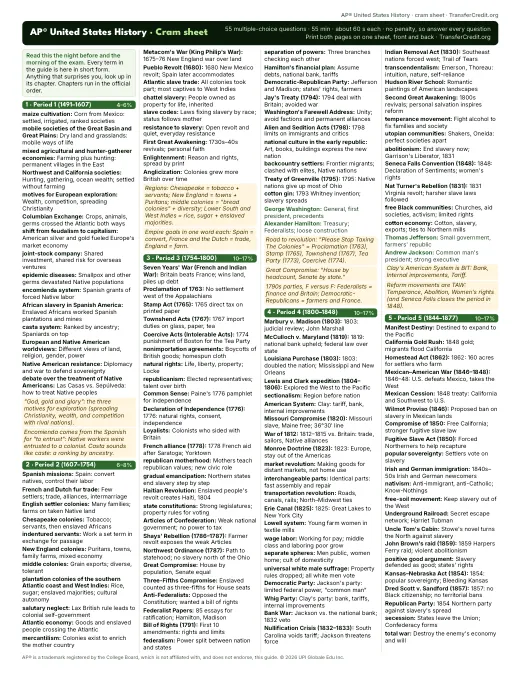
- Marbury v. Madison (1803)
- The 1803 Supreme Court case that established judicial review: the Court's power to strike down laws that conflict with the Constitution.
- Example: Chief Justice John Marshall ruled part of the Judiciary Act of 1789 unconstitutional, so the Court could not order Marbury's commission delivered.
- sectionalism
- Loyalty to one's own region (North, South or West) over the nation as a whole. Regional interests often decided leaders' positions on slavery and economic policy.
- Example: In the 1820s, Western leaders wanted cheap land and roads, Northern leaders wanted tariffs, and Southern leaders defended slavery.
- War of 1812
- A war with Britain, from 1812 to 1815, fought over British interference with American trade, the impressment of U.S. sailors, and British support for American Indian resistance.
- Example: Tecumseh's confederacy fought alongside the British, and his death in battle in 1813 weakened Native resistance around the Great Lakes.
- market revolution
- The early-1800s shift from local, semi-subsistence production to a market economy, in which goods were made in a more organized way and sold to distant buyers.
- Example: Instead of weaving cloth at home, many rural families began buying factory-made cloth with money earned by selling crops.
- Lowell system
- A New England factory model that hired young, unmarried women from farms to run textile machines and housed them in supervised company boardinghouses.
- Example: Mill workers in Lowell, Massachusetts, labored long hours, and in the 1830s some walked out to protest pay cuts.
- universal white male suffrage
- The vote for all adult white men, won as states dropped property requirements in the early 1800s. Politics grew more participatory, but women and most Black men stayed excluded.
- Example: Party conventions, parades and campaign rallies drew huge crowds, and voter turnout in presidential elections climbed in the 1830s and 1840s.
- transcendentalism
- A philosophical and literary movement, shaped by Romantic ideas, holding that people find truth through intuition and nature; it stressed self-reliance and individual conscience.
- Example: Ralph Waldo Emerson urged Americans to trust themselves, and Henry David Thoreau lived simply beside Walden Pond to study nature.
- Second Great Awakening
- Protestant revivals of the early 1800s, fueled by democratic and individualistic beliefs, a reaction against rationalism, and market-revolution changes; they inspired moral and social reforms.
- Example: At revivals in upstate New York, Charles Finney preached that anyone could choose salvation and should then work to improve society.
- Nat Turner's Rebellion (1831)
- An 1831 uprising of enslaved people in Southampton County, Virginia, led by the preacher Nat Turner, that killed dozens of white people before it was crushed.
- Example: Afterward, Virginia passed harsher laws barring Black people from preaching or leading their own religious meetings.
- McCulloch v. Maryland (1819)
- The 1819 Supreme Court case that upheld the Second Bank of the United States and ruled that a state cannot tax a federal institution, because federal law is supreme.
- Example: When Maryland taxed the Baltimore branch of the national bank, Marshall's Court struck the tax down, citing Congress's implied powers.
- American System
- Henry Clay's plan to unify the national economy through a protective tariff, a national bank and federally funded internal improvements such as roads and canals.
- Example: Southern critics said its tariff helped Northern factories while raising prices for farmers, who bought manufactured goods and sold crops abroad.
- Monroe Doctrine (1823)
- President James Monroe's 1823 declaration that European powers must not create new colonies or interfere in the Western Hemisphere, while the U.S. stayed out of European affairs.
- Example: As Latin American nations won independence from Spain, the U.S. warned Europe's monarchies against trying to reconquer them.