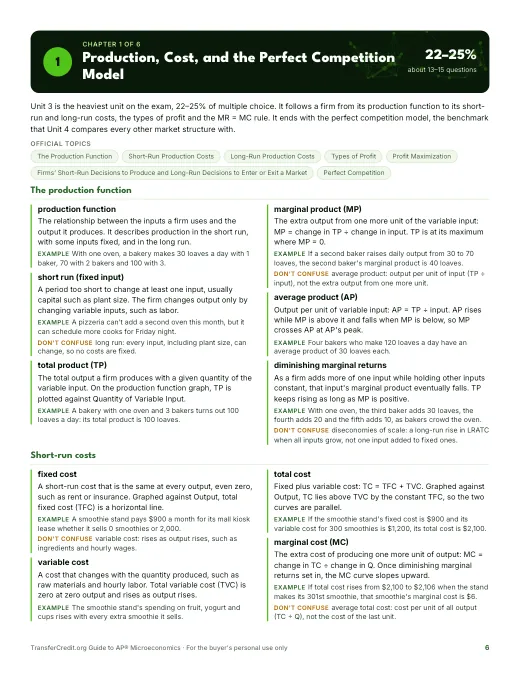
Unit 3 is the heaviest unit on the exam, 22–25% of multiple choice. It follows a firm from its production function to its short-run and long-run costs, the types of profit and the MR = MC rule. It ends with the perfect competition model, the benchmark that Unit 4 compares every other market structure with.
- production function
- The relationship between the inputs a firm uses and the output it produces. It describes production in the short run, with some inputs fixed, and in the long run.
- Example: With one oven, a bakery makes 30 loaves a day with 1 baker, 70 with 2 bakers and 100 with 3.
- fixed cost
- A short-run cost that is the same at every output, even zero, such as rent or insurance. Graphed against Output, total fixed cost (TFC) is a horizontal line.
- Example: A smoothie stand pays $900 a month for its mall kiosk lease whether it sells 0 smoothies or 2,000.
- long run (all inputs variable)
- A period long enough for a firm to change all its inputs, including plant size and equipment, so all costs become variable and none is fixed.
- Example: Given time to plan, a brewery can build a second building and buy bigger tanks; no input is fixed.
- accounting profit
- Total revenue minus explicit costs. It ignores implicit costs, such as the owner's time and the return the owner's money could earn elsewhere.
- Example: A tutoring business earns $90,000 in fees and spends $50,000 on its office and supplies: an accounting profit of $40,000.
- total revenue (TR)
- The money a firm receives from selling its output: TR = P × Q. Total revenue is the firm's total benefit; subtracting total cost from it gives profit.
- Example: A farm that sells 800 bushels of wheat at $6 a bushel earns total revenue of $4,800.
- shutdown rule
- In the short run, a firm keeps operating if P ≥ AVC (TR ≥ TVC) and shuts down if P < AVC. A firm that shuts down loses exactly its fixed cost.
- Example: A ski lodge whose lift-ticket revenue covers staff and heating but not its mortgage stays open: closing would lose the whole mortgage payment.
- perfect competition
- A market structure with many firms selling an identical product, no barriers to entry or exit and no market power, so each firm takes the market price.
- Example: Thousands of farms sell identical soybeans; no single farm can change the market price by growing more or less.
- short run (fixed input)
- A period too short to change at least one input, usually capital such as plant size. The firm changes output only by changing variable inputs, such as labor.
- Example: A pizzeria can't add a second oven this month, but it can schedule more cooks for Friday night.
- variable cost
- A cost that changes with the quantity produced, such as raw materials and hourly labor. Total variable cost (TVC) is zero at zero output and rises as output rises.
- Example: The smoothie stand's spending on fruit, yogurt and cups rises with every extra smoothie it sells.
- returns to scale
- How output responds when a firm raises all inputs by the same percentage in the long run: by a larger percentage (increasing), the same (constant) or a smaller one (decreasing).
- Example: Doubling every input at a bottling plant raises output from 10,000 to 25,000 bottles a day, more than double: increasing returns to scale.
- economic profit
- Total revenue minus all costs, explicit and implicit (opportunity costs). Firms respond to economic profit, not accounting profit, when they decide to enter or exit.
- Example: If the tutor could earn $45,000 teaching at a school, her $40,000 accounting profit is a $5,000 economic loss.
- marginal revenue (MR)
- The extra revenue from selling one more unit: MR = change in TR ÷ change in Q. For a price taker, MR equals the market price.
- Example: If selling an 801st bushel raises the farm's revenue from $4,800 to $4,806, its MR is $6, the market price.