← All AP® study guides
AP® Study Guide Printable PDF · 54 pages

TransferCredit.org Guide to AP® World History: Modern

AP® World History: Modern study guide: a printable PDF built from the College Board's official course and exam description, in the official order.

  • 178 key terms, each with an example
  • 45 practice questions with every answer explained
  • A 2-page cram sheet for the night before
  • 2-, 4- and 8-week study plans built from the exam weights
Not sure yet? Try 10 free questions

Last updated 2026 · exam details checked against the College Board's published exam information in 2026

Look inside the guide

Real pages from the 54-page PDF.

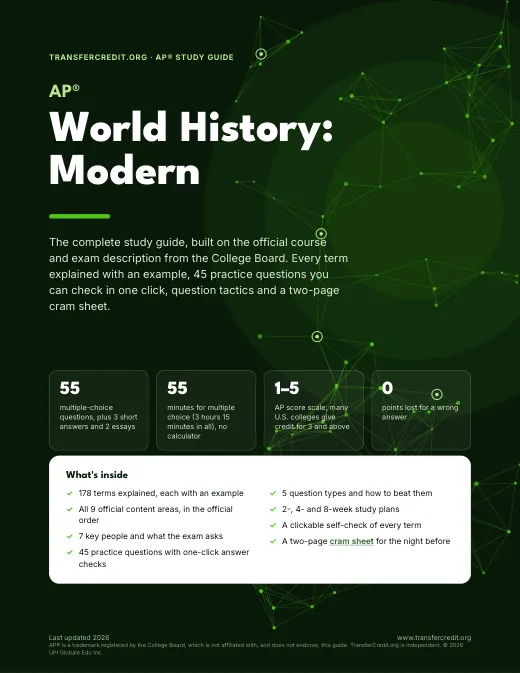
Page 1 of the TransferCredit.org Guide to AP® World History: Modern: the cover
Page 1 The cover
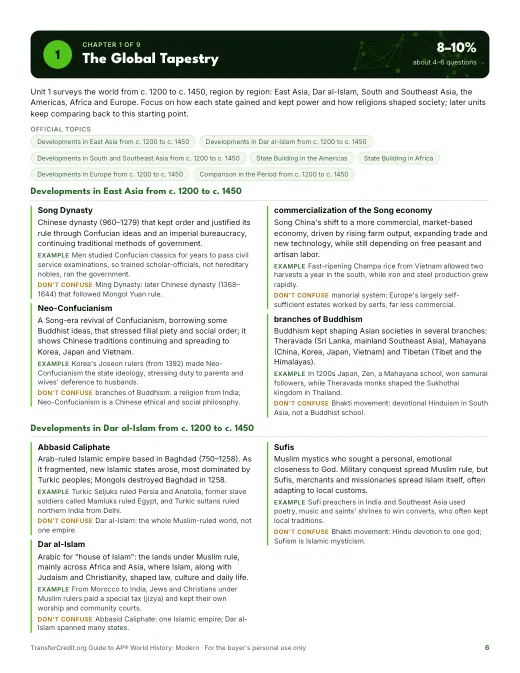
Page 6 of the TransferCredit.org Guide to AP® World History: Modern: the Chapter 1 opener
Page 6 The Chapter 1 opener
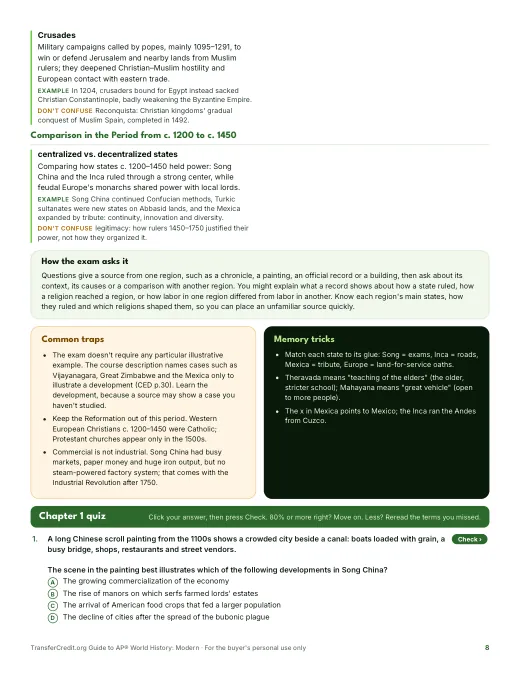
Page 8 of the TransferCredit.org Guide to AP® World History: Modern: a chapter quiz
Page 8 A chapter quiz
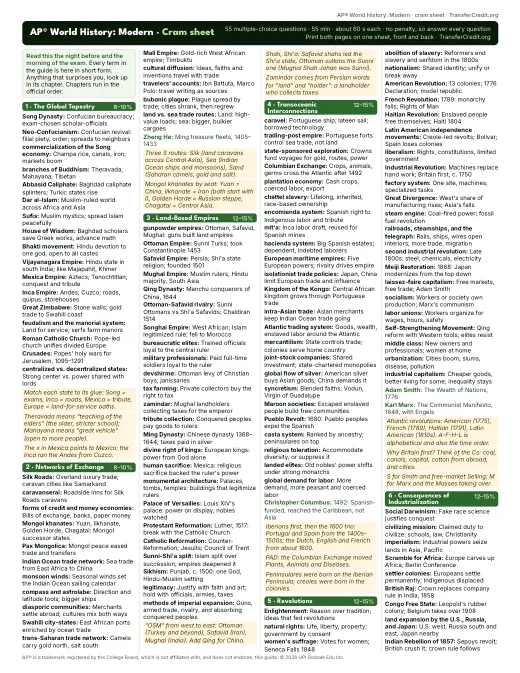
Page 53 of the TransferCredit.org Guide to AP® World History: Modern: the 2-page cram sheet
Page 53 The 2-page cram sheet

What you get for $5

One chapter for each area of the official course and exam description, in the official order.

  • 📘54pages, printable
  • 🧭9chapters
  • 🔑178terms with examples
  • ✍️45practice questions, answers explained
  • ⚠️24exam traps to avoid
  • 📄2page cram sheet

Try 10 free AP® World History: Modern questions

Multiple-choice questions taken from the guide's chapter quizzes: 9 areas, heaviest first. About 10 minutes, with every answer explained and a score by area. The exam's free-response questions aren't in this quiz: see how the exam works.

10 questions  
  1. Question 1 · Land-Based Empires
    A Mughal court painting from the early 1600s shows the emperor with a glowing halo around his head, seated above bowing nobles and foreign envoys.

    The painting was most likely intended to
    Show the answer

    Answer: D. present the emperor as a ruler favored by God and worthy of loyalty. Court artists worked for the emperor. A halo marks sacred favor, and bowing nobles and envoys show his supremacy, so the painting uses art and religious imagery to legitimize his rule.

    The trap: The Sikhism choice is wrong: Sikhism was a new faith outside the court, and Mughal emperors never made it the state religion.

  2. Question 2 · Transoceanic Interconnections
    A Spanish colonial report from the 1580s complains that Andean villages have few men left, because each year a share of them must travel far away to work in silver mines.

    The labor practice described in the report best illustrates which of the following continuities in the period 1450–1750?
    Show the answer

    Answer: A. Colonial rulers' use of existing Indigenous labor systems. The Spanish reused the Inca mit'a, a rotating labor draft that existed before the conquest, to staff the silver mines. An Indigenous labor system kept going under new rulers, which is a continuity.

    The trap: Chattel slavery is tempting because the work was forced, but mit'a workers were drafted in turns, not owned for life.

  3. Question 3 · Revolutions
    A pamphlet published in Paris in 1789 argues that the common people make up nearly the whole nation and that sovereignty belongs to the nation, not to the king or the privileged orders of clergy and nobles.

    The argument in the pamphlet most directly reflects which of the following?
    Show the answer

    Answer: C. Enlightenment ideas that a government's authority comes from the people. Placing sovereignty in the nation rather than the king applies Enlightenment ideas of popular sovereignty and the social contract, which shaped the French Revolution.

    The trap: The socialist choice is the wrong period and target: socialist ideas about owning production spread in the 1800s, and the pamphlet attacks royal and noble privilege, not factory owners.

  4. Question 4 · Consequences of Industrialization
    A British magazine cartoon from the 1890s shows a giant British colonial figure standing with one foot in Cape Town and the other in Cairo, stretching a telegraph wire between them.

    The cartoon most directly reflects which of the following developments?
    Show the answer

    Answer: B. European states' expansion of their empires across Africa. A giant figure spanning Africa from south to north captures Britain's ambition, during the Scramble for Africa, to control territory across the whole continent.

    The trap: The Mahdist revolt did challenge Britain, but Britain reconquered Sudan in 1898, and the cartoon celebrates British power rather than its decline.

  5. Question 5 · The Global Tapestry
    A long Chinese scroll painting from the 1100s shows a crowded city beside a canal: boats loaded with grain, a busy bridge, shops, restaurants and street vendors.

    The scene in the painting best illustrates which of the following developments in Song China?
    Show the answer

    Answer: D. The growing commercialization of the economy. Crowded markets, shops and grain boats on a canal show trade and commerce booming. That reflects the commercialization of the Song economy, built on higher farm output, canals and new technology.

    The trap: American food crops are tempting because the painting shows grain, but they reached China only after the Columbian Exchange began in the 1500s.

  6. Question 6 · Networks of Exchange
    A Persian chronicle written around 1300 by an official of the Mongol Ilkhanate praises the khan for securing the roads, protecting merchants and inviting physicians and scholars from China to his court.

    Which of the following best explains the chronicle's point of view?
    Show the answer

    Answer: A. Its author served the Mongol state and had reason to portray the khan favorably.. The chronicle comes from an official of the Ilkhanate. Writers who served a ruler had reason to praise that ruler, so the author's position shapes the glowing picture.

    The trap: The missionary choice doesn't fit: the source is a Persian official's chronicle, and its praise reflects service to the khan, not a hope of converting him.

  7. Question 7 · Global Conflict
    A British recruiting poster from 1915 shows a woman and two children at a window, watching soldiers march away, with a caption urging men to go to war.

    The poster best illustrates which of the following features of World War I?
    Show the answer

    Answer: C. Propaganda used to mobilize entire populations. The poster uses family feeling to push men to enlist, an example of the propaganda governments used to mobilize entire societies in a total war.

    The trap: Fascist regimes glorified war too, but they rose to power only after World War I had ended.

  8. Question 8 · Cold War and Decolonization
    A Soviet poster from around 1960 shows African and Asian workers breaking chains marked with the names of Western colonial powers, beneath a red star.

    The poster was most likely intended to
    Show the answer

    Answer: B. link communism with the struggle against colonial rule. The red star marks the poster as communist, and the broken chains show colonized peoples freeing themselves from Western empires. The message ties the Soviet cause to anti-imperialism.

    The trap: The Warsaw Pact choice is wrong: the poster speaks to colonized Africans and Asians, not western Europeans, and western European states joined NATO, not the Soviet alliance.

  9. Question 9 · Globalization
    A line graph of world population from 1900 to 2000 shows steady growth that speeds up sharply after 1950.

    Which of the following most directly contributed to the faster growth after 1950?
    Show the answer

    Answer: B. Higher crop yields and medical advances such as vaccines and antibiotics. More food from the Green Revolution and better survival from vaccines and antibiotics lowered death rates, so population rose faster.

    The trap: Birth control spread in the same decades, but it lowered birth rates, slowing growth rather than speeding it up.

  10. Question 10 · Land-Based Empires
    Refer to the source in the previous question. The painting is best understood as a continuation of which long-standing practice?
    Show the answer

    Answer: A. Rulers using religious imagery and art to legitimize their power. Long before 1450, rulers used religion and art to justify their power, and the land-based empires of 1450–1750 kept up the practice, as this painting shows.

    The trap: Selling tax-collection rights (tax farming) was a way to raise revenue and keep control, not a way to show that the ruler deserved power.

The AP® World History: Modern exam at a glance

The AP® World History: Modern exam is from the College Board. It has 55 multiple-choice questions, plus 3 short answers and 2 essays. You get 55 minutes for multiple choice (3 hours 15 minutes in all), no calculator. The score scale is 1–5 (AP® score scale; many U.S. colleges give credit for 3 and above). The guide has 9 chapters, one for each area of the official course and exam description; the heaviest is Land-Based Empires at 12–15%.

Questions
55multiple-choice questions, plus 3 short answers and 2 essays
Time
55 minfor the 55 multiple-choice questions, about 60 seconds a question
Score
1–5AP® score scale; many U.S. colleges give credit for 3 and above
Fee
$99per exam in the U.S. and Canada in 2026-27; your school may charge more
Calculator
Nonot allowed
Wrong answers
No penaltya wrong answer costs nothing
  • Section I has 55 multiple-choice questions in 55 minutes (40% of your score) and 3 short-answer questions in 40 minutes (20%). Section II has a document-based question (60 minutes recommended, including a 15-minute reading period, 25%) and a long essay question (40 minutes recommended, 15%).
  • The multiple-choice questions usually come in sets of 3–4 on the same source: primary and secondary texts, images such as artwork, photos, posters and cartoons, charts or other data, and maps. At least one set gives you a pair of text sources.
  • The exam is fully digital: you answer every question in the Bluebook testing app. No calculator is allowed.
  • Your multiple-choice score is the number of questions you answer correctly, so a wrong answer costs nothing.
  • The course runs from c. 1200 to the present. Units 3–6 (c. 1450 to c. 1900) are 12–15% of the exam each; Units 1, 2, 7, 8 and 9 are 8–10% each. Unit dates are approximate: developments can begin before or continue after them.

Source: official AP® World History: Modern page and the official course and exam description. Last updated 2026.

What the exam covers

9 chapters, in the official order, with each area's official weight. The guide's chapters follow this order.

  1. The Global Tapestry8–10% · ~4–6 Q
  2. Networks of Exchange8–10% · ~4–6 Q
  3. Land-Based Empires12–15% · ~7–8 Q
  4. Transoceanic Interconnections12–15% · ~7–8 Q
  5. Revolutions12–15% · ~7–8 Q
  6. Consequences of Industrialization12–15% · ~7–8 Q
  7. Global Conflict8–10% · ~4–6 Q
  8. Cold War and Decolonization8–10% · ~4–6 Q
  9. Globalization8–10% · ~4–6 Q

Where to start: the 6 heaviest areas (marked in the map) carry about 40 of the 55 questions. The chapters run in the official order, so start with those.

AP® World History: Modern study guide by area

The 2 heaviest areas are open to read now. The full guide has a chapter for every area, each with all its terms, a quiz and an answer key.

2 of 9 chapters open  ·  in the guide's order
12–15% · about 7–8 questions · free preview Land-Based Empires Chapter 3 of the guide

Unit 3 covers c. 1450 to c. 1750, when gunpowder helped the Ottoman, Safavid, Mughal and Qing empires conquer vast lands. Focus on how rulers legitimized and consolidated their power (religion, art, buildings, officials, soldiers and taxes) and on how religious change and rivalry shaped these empires.

Key terms, with examples

gunpowder empires
Historians' label for the Ottoman, Safavid and Mughal empires. Like other expanding states after c. 1450, they relied on firearms and cannons to conquer and control large territories.
Example: At Panipat in 1526, Babur's field guns and muskets helped defeat the larger army of the Delhi Sultanate, founding Mughal rule in India.
bureaucratic elites
Officials chosen and trained to serve the ruler, often by merit or exams, rather than holding power through birth or local land. They helped rulers keep centralized control.
Example: Qing emperors staffed their government with scholar-officials who passed civil service exams on Confucian classics, and paired Manchu and Han officials in top posts.
Protestant Reformation
A 1500s movement in Europe that broke with the Roman Catholic Church, rejecting papal authority and many Church practices, and created new Protestant churches.
Example: In 1517, Martin Luther's Ninety-Five Theses attacked the sale of indulgences; printed copies spread his ideas quickly across the German states.
legitimacy
The accepted right to rule. Rulers in 1450–1750 legitimized power through religion, art and buildings, and consolidated it through bureaucracies, paid armies and new taxes.
Example: European kings used divine right and palaces like Versailles; Mughals built grand tombs; the Mexica used sacrifice; the Qing used Confucian exams.
Ottoman Empire
Turkish Sunni Muslim land empire (c. 1300–1922) that expanded across Southern Europe, the Middle East and North Africa, using cannons and janissary troops.
Example: In 1453, Ottoman cannons broke the walls of Constantinople, ending the Byzantine Empire; the city became the Ottoman capital, Istanbul.
military professionals
Full-time soldiers trained, paid and controlled by the ruler rather than by local nobles. Rulers wanting centralized control over people and resources relied on them more after 1450.
Example: Ottoman janissaries were salaried infantry armed with firearms; in Tokugawa Japan, samurai became salaried servants of their lords rather than landholders.
Catholic Reformation
The Catholic Church's response to Protestantism in the 1500s and 1600s: it reformed abuses, restated its teachings and sent missionaries abroad, helping Christianity grow worldwide.
Example: The Jesuits, founded in 1540, ran schools in Europe and sent missionaries to Asia and the Americas; Francis Xavier preached in India and Japan.
methods of imperial expansion
Comparison of how 1450–1750 empires grew and held diverse peoples: gunpowder conquest, armed trade, wars fed by religious and political rivalry, and recruiting conquered peoples into service.
Example: The Ottomans took Constantinople with cannons and recruited Balkan Christians through the devshirme; the Qing conquered China, sharing top posts between Manchu and Han officials.
Safavid Empire
Land empire in Persia, founded in 1501 and centered on present-day Iran, whose rulers made Shi'a Islam the state religion and fought the Sunni Ottomans.
Example: Shah Abbas I (ruled 1588–1629) built a gunpowder army and made Isfahan a grand capital of mosques, gardens and bazaars.
devshirme
The Ottoman levy of Christian boys, mostly from the Balkans, who were converted to Islam and trained as officials or janissary soldiers loyal only to the sultan.
Example: A boy taken from a Serbian village could rise through palace schooling to become a governor or even grand vizier, owing everything to the sultan.
Sunni-Shi'a split
Islam's division over succession after Muhammad: Shi'a Muslims hold leadership belonged to Ali's line; Sunnis accepted the community's caliphs. Ottoman-Safavid rivalry sharpened it.
Example: After 1501 the Safavids made Shi'a Islam compulsory in Persia, while the Sunni Ottomans persecuted Shi'a supporters of the Safavids inside Anatolia.
Mughal Empire
Muslim land empire in South and Central Asia (1526–1857) whose rulers governed a mostly Hindu population, at times through religious tolerance.
Example: Akbar (ruled 1556–1605) abolished the special tax on non-Muslims and brought Hindus into high office, strengthening loyalty across his empire.

What this area covers

Empires ExpandEmpires: AdministrationEmpires: Belief SystemsComparison in Land-Based Empires

How the exam asks it

Questions usually give a source from an empire, such as a court painting, a decree, a tax record or a description of a palace, and ask how it shows a ruler gaining or keeping power, or how it compares with another empire. Sort each method into one of two jobs: convincing people the ruler deserves power, or controlling people and resources. Belief-system questions often ask what caused a religious split or rivalry, or how a religion changed.

Common traps

Trap 1. Mughals are not the Mongols. The Mughal dynasty belongs to this unit; its founder Babur claimed descent from Timur and Chinggis Khan, but the Mongol khanates belong to Unit 2.

Trap 2. Keep land and sea empires apart. This unit's empires grew mainly by conquest over land; the Portuguese and Spanish ocean empires of the same years are Unit 4 material.

Trap 3. Don't treat the Reformation as purely religious. Many northern European rulers backed Protestantism partly to gain Church lands and independence from the pope.

Memory trick

"OSM" from west to east: Ottoman (Turkey and beyond), Safavid (Iran), Mughal (India). Add Qing for China.

Shah, Shi'a: Safavid shahs led the Shi'a state, Ottoman sultans the Sunni one (Mughal Shah Jahan was Sunni).

12–15% · about 7–8 questions · free preview Transoceanic Interconnections Chapter 4 of the guide

Unit 4 covers 1450 to 1750, when European ships linked the Eastern and Western Hemispheres for the first time. Focus on why states sponsored voyages, what the Columbian Exchange moved, which labor systems built the new colonial economies, and how societies and states resisted or adapted.

Key terms, with examples

caravel
A small Portuguese ship with lateen sails that could sail against the wind; with new tools and better knowledge of winds and currents, such designs made ocean voyages possible.
Example: Its triangular lateen sail came from Mediterranean and Arab seafaring, its compass from China; the carrack and Dutch fluyt were other new designs.
trading-post empire
Portugal's network of fortified coastal trading posts in Africa and Asia, built on new maritime technology and navigation skills; it aimed to control trade rather than large territories.
Example: After Vasco da Gama reached India by sea in 1498, Portugal seized ports such as Goa (1510) and Malacca (1511).
Columbian Exchange
The exchange of plants, animals and diseases between the Eastern and Western Hemispheres after 1492; Afro-Eurasian diseases devastated Indigenous Americans, while American crops improved Afro-Eurasian diets.
Example: Potatoes, maize and cassava became staples in Europe, Asia and Africa, while Europeans brought wheat, sugar, horses, cattle and pigs to the Americas.
chattel slavery
A new labor system: in the Americas, enslaved Africans and their children became property for life. Africa's traditional slavery, by contrast, often absorbed enslaved people into households.
Example: A 1662 Virginia law made enslavement pass from mother to child; in Africa, older slave trades to the Mediterranean and Indian Ocean continued.
Atlantic trading system
Movement of goods, wealth and labor, including millions of enslaved Africans, linking Europe, Africa and the Americas; taking more men than women, it reshaped West African families and societies.
Example: Ships carried guns and cloth to West Africa, enslaved Africans across the Middle Passage to the Americas, and sugar and tobacco to Europe.
Maroon societies
Communities of people who escaped slavery, often hidden in mountains or forests; a leading example of enslaved people challenging authorities in the Americas through organized resistance.
Example: Palmares, a maroon state of thousands in northeastern Brazil, fought off Portuguese and Dutch attacks for most of the 1600s.
casta system
Spanish America's social hierarchy ranked by ancestry and birthplace: Spanish-born peninsulares at the top, then creoles, mestizos and mulattoes, with Indigenous and African people at the bottom.
Example: Peninsulares held top colonial offices over creoles; similarly, conquest made Manchus a new ruling elite in Qing China after 1644.
global demand for labor
Rising world demand for raw materials and finished goods after 1450, which intensified labor: peasant and artisan work grew, plantations expanded and the Atlantic slave trade intensified.
Example: Indian weavers made more cotton cloth and Chinese households more silk for export, while sugar colonies demanded ever more enslaved Africans.
state-sponsored exploration
Voyages funded by monarchs for wealth, trade routes and power. Spain's backing of Columbus raised European interest in ocean trade; England, France and the Dutch sought northern routes to Asia.
Example: Magellan's Spanish-funded fleet sailed around the world (1519–1522); John Cabot for England and Jacques Cartier for France searched North America for a passage.
plantation economy
Large American estates growing cash crops such as sugar and tobacco with coerced labor, mostly for export to Europe and the Middle East; its growth drove demand for enslaved Africans.
Example: Sugar plantations in Brazil and the Caribbean imported so many enslaved Africans that they outnumbered Europeans in many colonies.
encomienda system
A Spanish grant giving a colonist the right to the labor and tribute of Indigenous people, in return for supposed protection and Christian instruction; abuse was widespread.
Example: Spanish settlers on Hispaniola forced Taino people to work fields and gold mines; the friar Bartolomé de Las Casas condemned the abuses.
mercantilism
Rulers' policy of building state wealth by controlling trade: colonies supplied raw materials and bought finished goods, and the state tried to export more than it imported.
Example: England's 1651 Navigation Act required colonial trade to use English ships, feeding wars with the Dutch; trade rivalry also drove Morocco's 1591 invasion of Songhai.

What this area covers

Technological Innovations from 1450 to 1750Exploration: Causes and Events from 1450 to 1750Columbian ExchangeMaritime Empires EstablishedMaritime Empires Maintained and DevelopedInternal and External Challenges to State Power from 1450 to 1750Changing Social Hierarchies from 1450 to 1750Continuity and Change from 1450 to 1750

Key people

Christopher ColumbusGenoese navigator who sailed west for Spain's monarchs in 1492, hoping to reach Asia, and instead reached the Caribbean, beginning lasting contact between the hemispheres.

How the exam asks it

Sources here are often maps, colonial reports and laws, trade records, paintings and letters from rulers or missionaries. Questions ask what drove exploration, what effect a crop, disease or labor system had, how a writer's position shapes a source, or what stayed the same over the period. Know which labor system belongs to which colony, and keep the Portuguese, Spanish, Dutch, French and British models apart.

Common traps

Trap 1. The Columbian Exchange wasn't only European. Enslaved Africans brought foods such as okra and rice, and mosquitoes spread malaria.

Trap 2. Restricting Europeans isn't the same as closing off trade. Japan and China set limits on their own terms, yet China stayed a huge buyer of American silver.

Memory trick

Iberians first, then the 1600 trio: Portugal and Spain from the 1400s–1500s; the Dutch, English and French from about 1600.

PAD: the Columbian Exchange moved Plants, Animals and Diseases.

How AP® World History: Modern questions are written

The exam has 55 multiple-choice questions, plus 3 short answers and 2 essays. The guide sorts the questions into 5 types; spot the type and you'll know what the question wants before you read the choices.

Type 1

Contextualization

One question in a set of 3–4 on the same source asks which broader development or situation best explains why the source was made or what it shows.

  • Read the source line first and note its date and place.
  • Name the big development under way in that place at that time before you look at the choices.
  • Cross out choices from the wrong period or region; prefer a broad process over a narrow detail.
Type 2

Causation

One question in a set of 3–4 on the same source asks what most directly caused the development the source shows, or what it led to.

  • Name the development in the source in a few words.
  • Check the time order: a cause comes before its effect.
  • Choose the most direct link; a true but distant development is the usual distractor.
Type 3

Comparison and continuity or change

One question in a set of 3–4 on the same source asks which development is most similar to the one shown, how two cases differ, or what stayed the same over time.

  • Sum up the key feature of the source: who acts, how and why.
  • Find the choice that shares that feature, even if it comes from another region or period.
  • For continuity, choose what lasted across the time span; for change, choose what was new.
Type 4

Sourcing: point of view, purpose, situation and audience

One question in a set of 3–4 on the same source asks about the author's point of view, purpose, historical situation or audience, or how one of these limits what the source can show.

  • Read the source line: who made it, when, for whom and why.
  • Ask what the author wanted the audience to believe or do.
  • For a limitation, pick what the author's position would lead them to leave out or exaggerate.
Type 5

Claims and evidence

A secondary source, or a pair of sources, makes an argument, and one question in the set of 3–4 asks which evidence would best support, modify or refute it, or how two arguments differ.

  • Put each author's claim into one short sentence before reading the choices.
  • Test each choice: if true, would it make the claim stronger, weaker or neither?
  • Ignore choices that are true but don't bear on the claim.

Test-day habits that add points

  1. Answer every question. There's no penalty for a wrong answer. A blank is always worth zero, so never leave one.
  2. Predict, then look. Name the answer before reading the choices. It protects you from distractors written to sound right.
  3. Eliminate. Cross out choices you know are wrong. Every choice you rule out raises your odds on a guess.
  4. Mark and move on. If a question takes more than a minute, pick your best guess, mark it and come back if time allows.
  5. Watch absolute words. Choices with "always", "never" or "only" are often wrong, because most rules and findings have exceptions. Treat this as a tiebreaker, not a rule.
  6. Change answers for a reason. Switch an answer only when you can say why the new one is better, such as a detail you missed.
  7. The three short-answer questions. Section I, Part B: 3 required short-answer questions in 40 minutes (20% of your score). Question 1 gives a secondary text source, question 2 a primary text source, and question 3 a primary or secondary non-text source such as an image, chart or map. Each one covers a different period between 1200 and 2001. In the course description's sample, the question has three parts worth 1 point each: answer every part directly, with one specific, accurate example.
  8. The document-based question (DBQ). Section II: 60 minutes recommended, including a 15-minute reading period (25% of your score). You get 7 documents on one development between 1200 and 2001. The 7-point rubric rewards a defensible thesis (1 point), a broader historical context (1), using the content of at least 4 documents to support an argument (2; 1 for describing 3), one more piece of specific evidence from outside the documents (1), explaining for at least 2 documents how point of view, purpose, historical situation or audience matters to your argument (1), and a complex understanding (1).
  9. The long essay question (LEQ). Section II: 40 minutes recommended (15% of your score). One required prompt covers about half of the course's time span, and you may focus on one or more of the developments it names. The 6-point rubric rewards a defensible thesis (1 point), a broader historical context (1), two specific pieces of evidence used to support an argument (2; 1 for only naming them), and comparison, causation or continuity and change used to structure the argument (1), or a complex understanding (2).

Pacing: 55 questions in 55 minutes, about 60 seconds a question.

AP® World History: Modern flashcards

Try the first 8 cards free. Read the term, say the definition out loud, then select the card to check yourself. Arrow keys move between cards.

Free card 1 of 8 (deck total: 178)

How to study for AP® World History: Modern: a 5-step plan

Follow the steps, then enter your test date. The planner gives you a dated plan that starts with the heaviest areas and saves the last days for review.

  1. Take the 10 free questionsSee which AP® World History: Modern areas you already know.
  2. Study the heaviest areas firstStart with Land-Based Empires, Transoceanic Interconnections and Revolutions, then work down the exam map.
  3. Learn each term with an exampleSay the definition out loud, then check it with the flashcards. A term you can't use in an example isn't learned yet.
  4. Quiz yourself and study the trapsAfter each area, answer its quiz and read why the tempting wrong answer is wrong.
  5. Plan backwards from your exam dateBuild a dated plan, keep the last days for a full review, and read the cram sheet the night before.

How it works

  1. 1Check outSelect Get the guide · $5 and pay on TransferCredit.org's secure checkout.
  2. 2Download the PDFFrom your TransferCredit.org account.
  3. 3Study the heaviest areas firstFollow the 2-, 4- or 8-week plan, then read the cram sheet the night before.

This page or the full guide

Everything on this page is free with no account. The full guide is a PDF you keep.

What's on this page and in the full study guide
Study toolThis pageFull study guide ($5)
ChaptersA preview of 2 of 9All 9
Terms explainedA sample from the open chaptersAll 178, each with an example
Practice questions10 free questions45, with an answer key
Flashcards8 cardsAll 178 terms on the self-check list
Study planDated planner2-, 4- and 8-week plans
Cram sheet—2 pages, for the night before
FormatWeb page54-page PDF, printable

Questions students ask

What's in the full AP® World History: Modern study guide?
54 pages: 9 chapters, one for each area of the College Board's official course and exam description, in the official order. 178 terms, each with a plain-English definition and an example, 7 key people, common traps and memory tricks, 45 practice questions with an answer key that explains every answer, question tactics, 2-, 4- and 8-week study plans and a 2-page cram sheet.
How much is the full AP® World History: Modern study guide?
The full 54-page PDF is $5. The 10 practice questions on this page are free.
How do I get the full guide?
Select Get the guide · $5 and check out on TransferCredit.org. Then sign in to your TransferCredit.org account to download the PDF.
Can I print the guide or use it on my phone?
Yes. It's a PDF, so it opens on phones, tablets and computers, and printing is allowed. Its tick boxes and answer bubbles work in PDF readers that support forms. Copying and editing are turned off.
Can I try the AP® World History: Modern guide before I buy it?
Yes. This page has 10 questions from the guide's own chapter quizzes, a preview of the 2 heaviest areas, 8 flashcards and a study planner. No account needed.
Is this an official AP® study guide?
No. AP® is a trademark registered by the College Board, which is not affiliated with, and does not endorse, this guide. TransferCredit.org is independent. We built the guide from the College Board's official course and exam description, and the exam details were checked against the College Board's published exam information in 2026.
How was this study guide made?
One chapter for each area of the official course and exam description, using its published weights. Each chapter was written, then fact-checked against the official exam information in a separate review. The practice questions are original: none are copied from the College Board's released questions.
How up to date is this AP® World History: Modern guide?
Last updated 2026. The exam details were checked against the College Board's published exam information in 2026. Exams change, so confirm the details on the official AP® World History: Modern page before you test.
More questions about the AP® World History: Modern exam (16)
What is the AP® World History: Modern exam?
The AP® World History: Modern exam is from the College Board. It has 55 multiple-choice questions, plus 3 short answers and 2 essays. You get 55 minutes for multiple choice (3 hours 15 minutes in all), no calculator. The score scale is 1–5 (AP® score scale; many U.S. colleges give credit for 3 and above). The guide has 9 chapters, one for each area of the official course and exam description; the heaviest is Land-Based Empires at 12–15%.
How many questions are on the AP® World History: Modern exam, and how long is it?
Section I has 55 multiple-choice questions in 55 minutes (40% of your score) and 3 short-answer questions in 40 minutes (20%). Section II has a document-based question (60 minutes recommended, including a 15-minute reading period, 25%) and a long essay question (40 minutes recommended, 15%).
How is the AP® World History: Modern exam scored?
The score scale is 1–5: AP® score scale; many U.S. colleges give credit for 3 and above. Your multiple-choice score is the number of questions you answer correctly, so a wrong answer costs nothing.
What AP® World History: Modern score do I need for college credit?
Many U.S. colleges give credit for 3 and above. Each college sets its own credit policy, so check the one at your college before you count on the credit.
How much does the AP® World History: Modern exam cost?
The fee is $99: per exam in the U.S. and Canada in 2026-27; your school may charge more. Fees can change, so check the official page when you register.
Can I use a calculator on the AP® World History: Modern exam?
No calculator is allowed.
Is there a penalty for guessing on AP® World History: Modern?
No. There's no penalty for a wrong answer. A blank is always worth zero, so never leave one.
What topics are on the AP® World History: Modern exam?
9 areas, from the official course and exam description: The Global Tapestry (8–10%); Networks of Exchange (8–10%); Land-Based Empires (12–15%); Transoceanic Interconnections (12–15%); Revolutions (12–15%); Consequences of Industrialization (12–15%); Global Conflict (8–10%); Cold War and Decolonization (8–10%); Globalization (8–10%).
Which AP® World History: Modern topics should I study first?
The 6 heaviest areas (marked in the map) carry about 40 of the 55 questions. The chapters run in the official order, so start with those.
Is the AP® World History: Modern exam hard?
It depends on what you already know. The largest area, Land-Based Empires, is 12–15%, and the smallest, Globalization, is 8–10%. Try the 10 free questions above to see where you stand in about 10 minutes.
What kinds of questions are on the AP® World History: Modern exam?
The exam has 55 multiple-choice questions, plus 3 short answers and 2 essays. The guide sorts the questions into 5 types: “Contextualization”, “Causation”, “Comparison and continuity or change”, “Sourcing: point of view, purpose, situation and audience” and “Claims and evidence”. Multiple-choice questions have 4 answer choices. See how each type is written.
What are the free-response questions on the AP® World History: Modern exam?
Section I, Part B: 3 required short-answer questions in 40 minutes (20% of your score). Question 1 gives a secondary text source, question 2 a primary text source, and question 3 a primary or secondary non-text source such as an image, chart or map. Each one covers a different period between 1200 and 2001. In the course description's sample, the question has three parts worth 1 point each: answer every part directly, with one specific, accurate example. Section II: 60 minutes recommended, including a 15-minute reading period (25% of your score). You get 7 documents on one development between 1200 and 2001. The 7-point rubric rewards a defensible thesis (1 point), a broader historical context (1), using the content of at least 4 documents to support an argument (2; 1 for describing 3), one more piece of specific evidence from outside the documents (1), explaining for at least 2 documents how point of view, purpose, historical situation or audience matters to your argument (1), and a complex understanding (1). Section II: 40 minutes recommended (15% of your score). One required prompt covers about half of the course's time span, and you may focus on one or more of the developments it names. The 6-point rubric rewards a defensible thesis (1 point), a broader historical context (1), two specific pieces of evidence used to support an argument (2; 1 for only naming them), and comparison, causation or continuity and change used to structure the argument (1), or a complex understanding (2).
How should I pace myself on the AP® World History: Modern exam?
55 questions in 55 minutes, about 60 seconds a question. If a question takes more than a minute, pick your best guess, mark it and come back if time allows.
How long should I study for AP® World History: Modern?
Take the 10 free questions to see where you stand. The full guide has 2-, 4- and 8-week plans built from the exam weights, and the planner on this page builds a dated plan from your exam date.
How do I know I'm ready for the AP® World History: Modern exam?
The guide's readiness checklist: You can explain every term on the checklist without notes. You score 80% or better on every chapter quiz. You can say what each person in the key people lists is known for. You can read the cram sheet and nothing on it surprises you. You know the AP® score your college gives credit for, and your exam date.
What should I do the night before?
Read the 2-page cram sheet once, slowly. Check your exam time and room with your AP® coordinator. The whole exam is taken in the Bluebook app. In the morning, skim the traps, then stop studying.

How we built this guide

We built one chapter for each area of the College Board's official course and exam description for AP® World History: Modern, using its published weights to order the chapters and size the quizzes. Each chapter was written, then fact-checked against the official exam information in a separate review. The exam details were checked against the College Board's published exam information in 2026.

Sources: official AP® World History: Modern page, official course and exam description. Last updated 2026.

AP® is a trademark registered by the College Board, which is not affiliated with, and does not endorse, this guide. TransferCredit.org is independent and not affiliated with the College Board. © 2026 UPI Globale Edu Inc.

Ready for the full AP® World History: Modern guide? 54 pages, 178 terms, 45 practice questions and a 2-page cram sheet, $5.

Get the guide · $5

In the full guide

TransferCredit.org Guide to AP® World History: Modern

  • All 9 chapters
  • 178 terms with examples and 7 key people
  • 45 practice questions with an answer key
  • A 2-page cram sheet and 2-, 4- and 8-week plans
Get the guide · $5