
$5one-time
- 34-page printable PDF
- 181 terms with examples
- 40 practice questions, answers explained
- 2-page cram sheet and study plans
Everything the DSST Lifespan Developmental Psychology exam tests, in one PDF you can print. Built from Prometric's official outline, heaviest topics first.
Last updated 2026 · exam details checked against Prometric's published exam information in 2026
Real pages from the 34-page PDF.
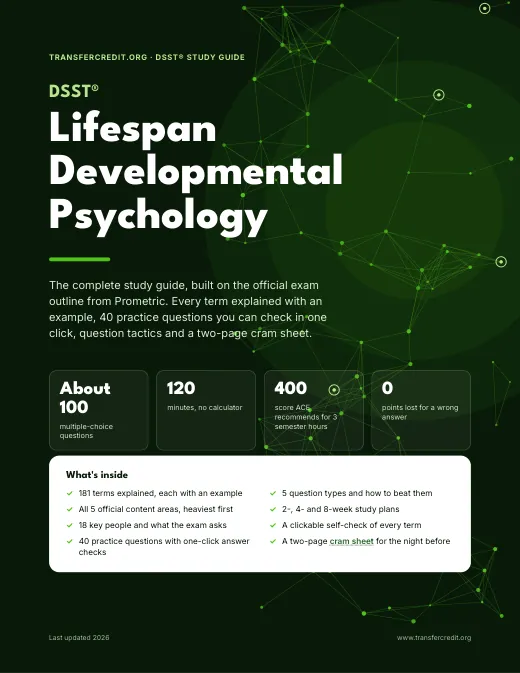
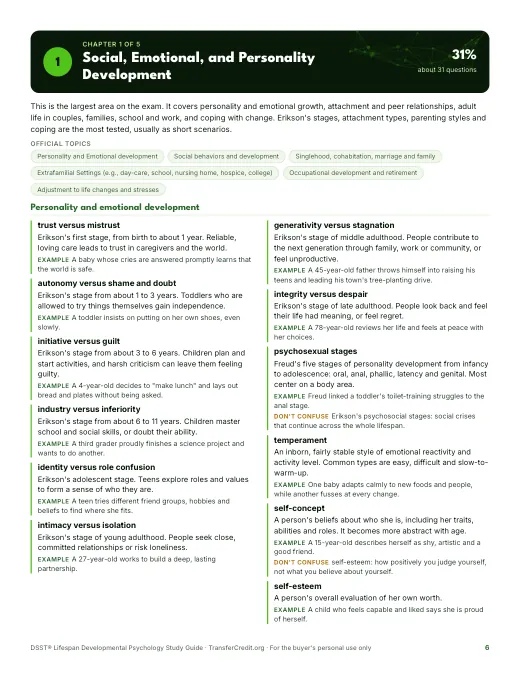
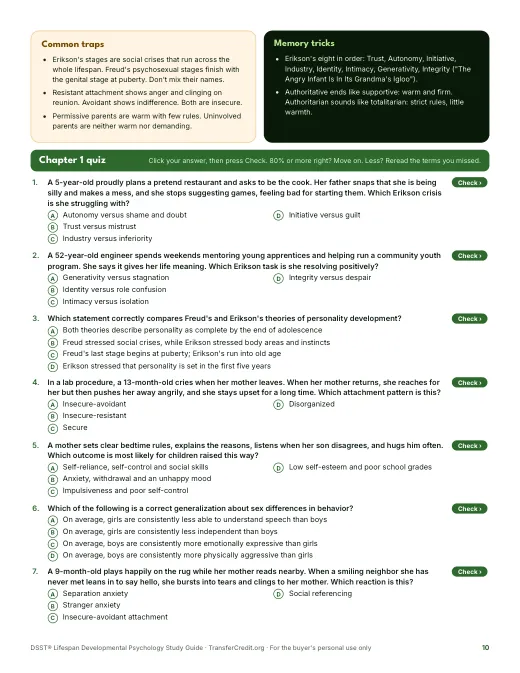
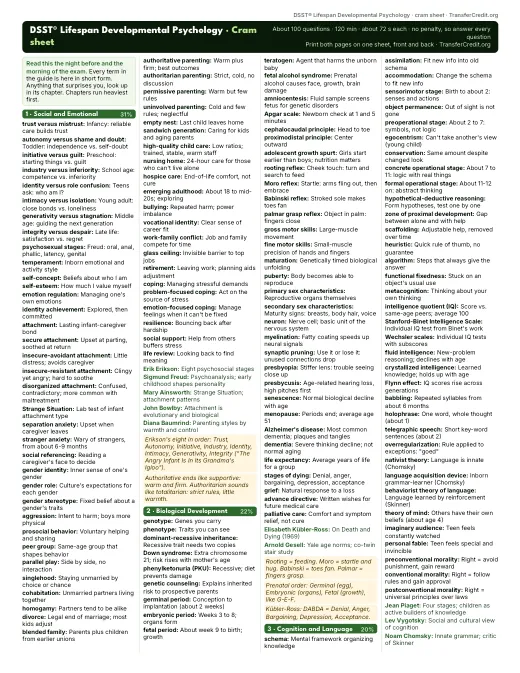
One chapter for each official content area, in the order the exam weighs them.
In the style of the real exam, from all 5 areas. About 10 minutes, with every answer explained and a score by area.
A 5-year-old proudly plans a pretend restaurant and asks to be the cook. Her father snaps that she is being silly and makes a mess, and she stops suggesting games, feeling bad for starting them. Which Erikson crisis is she struggling with?
Answer: D. Initiative versus guilt. Planning and starting activities fits ages 3 to 6, and harsh reactions lead to guilt. That is initiative versus guilt.
The trap: Industry versus inferiority is close, but it applies to school-age children mastering skills. This girl is a preschooler who feels guilty for starting things.
Planning and starting activities fits ages 3 to 6, and harsh reactions lead to guilt. That is initiative versus guilt.
The trap: Industry versus inferiority is close, but it applies to school-age children mastering skills. This girl is a preschooler who feels guilty for starting things.
A breastfeeding coach tells a new mother to brush the nipple against her baby's cheek so the baby will turn and latch on. Which reflex is the coach relying on?
Answer: A. Rooting. A touch on the cheek makes the baby turn toward it and open her mouth. That is rooting, the reflex that helps a baby find food.
The trap: Palmar grasp also starts with a touch, but it makes the fingers close around an object, not the head turn to feed.
A touch on the cheek makes the baby turn toward it and open her mouth. That is rooting, the reflex that helps a baby find food.
The trap: Palmar grasp also starts with a touch, but it makes the fingers close around an object, not the head turn to feed.
A 3-year-old watches water poured from a short, wide glass into a tall, thin glass and insists the tall glass now holds more. Which ability does this answer show the child lacks?
Answer: B. Conservation. The amount of water did not change, only its shape. Understanding that quantity stays the same despite a change in appearance is conservation, which preoperational children lack.
The trap: Object permanence is tempting because it is also a Piaget milestone, but it concerns objects out of sight, and children master it in infancy.
The amount of water did not change, only its shape. Understanding that quantity stays the same despite a change in appearance is conservation, which preoperational children lack.
The trap: Object permanence is tempting because it is also a Piaget milestone, but it concerns objects out of sight, and children master it in infancy.
Researchers show an infant two pictures at the same time, a face and a plain oval, and record that the baby looks at the face for much longer. This method most directly shows that the baby
Answer: C. can tell the two pictures apart. Looking longer at one of two choices shows the infant can distinguish them. This is the preferential looking method.
The trap: Object permanence is about knowing hidden objects still exist, which this task doesn't test.
Looking longer at one of two choices shows the infant can distinguish them. This is the preferential looking method.
The trap: Object permanence is about knowing hidden objects still exist, which this task doesn't test.
A researcher tests the memory of 20-, 40- and 60-year-olds during one month and compares the three groups. Which design is this?
Answer: A. Cross-sectional. Different age groups are measured at a single point in time, which is a cross-sectional design.
The trap: Longitudinal is tempting because ages are compared, but longitudinal studies follow the same people across years.
Different age groups are measured at a single point in time, which is a cross-sectional design.
The trap: Longitudinal is tempting because ages are compared, but longitudinal studies follow the same people across years.
A 52-year-old engineer spends weekends mentoring young apprentices and helping run a community youth program. She says it gives her life meaning. Which Erikson task is she resolving positively?
Answer: B. Generativity versus stagnation. Guiding and contributing to the next generation is the central task of middle adulthood: generativity versus stagnation.
The trap: Integrity versus despair is tempting because she finds meaning, but it belongs to late life and involves reviewing one's own past, not mentoring others.
Guiding and contributing to the next generation is the central task of middle adulthood: generativity versus stagnation.
The trap: Integrity versus despair is tempting because she finds meaning, but it belongs to late life and involves reviewing one's own past, not mentoring others.
Two parents who both have normal skin pigment each carry one recessive gene for albinism. What is the chance that a given child of theirs will have albinism?
Answer: D. 1 in 4. A recessive trait appears only when a child receives the recessive gene from both carrier parents, which happens in 1 of 4 cases.
The trap: None is tempting because neither parent shows the trait, but carriers can each pass on the recessive gene.
A recessive trait appears only when a child receives the recessive gene from both carrier parents, which happens in 1 of 4 cases.
The trap: None is tempting because neither parent shows the trait, but carriers can each pass on the recessive gene.
A toddler who knows the word "horse" calls a zebra "horse" at first. After her father points out the stripes, she creates a new category for zebras. Which process produced the new category?
Answer: C. Accommodation. Building a new category because the animal did not fit the old one changes the schema, which is accommodation.
The trap: Assimilation names her first reaction, calling the zebra a horse. The new category is the change, not the fit.
Building a new category because the animal did not fit the old one changes the schema, which is accommodation.
The trap: Assimilation names her first reaction, calling the zebra a horse. The new category is the change, not the fit.
A 10-month-old is shown the same toy over and over and looks at it for shorter and shorter periods. When a new toy appears, she looks longer. Which process explains the first change?
Answer: D. Habituation. Decreasing interest in a repeated stimulus is habituation. Looking longer at the new toy shows she notices the difference.
The trap: Extinction is the fading of a learned response when reinforcement stops, not decreased interest in a repeated stimulus.
Decreasing interest in a repeated stimulus is habituation. Looking longer at the new toy shows she notices the difference.
The trap: Extinction is the fading of a learned response when reinforcement stops, not decreased interest in a repeated stimulus.
A team follows 500 children from age 5 to age 25. By the end, many participants with low incomes have moved away and can't be reached. What is the most serious threat to the study's conclusions?
Answer: A. The remaining sample may no longer be representative. Nonrandom dropout is selective attrition. The people who remain differ from those who left, which biases results.
The trap: Comparing ages at one moment describes a cross-sectional design, not this one, which tracks the same participants.
Nonrandom dropout is selective attrition. The people who remain differ from those who left, which biases results.
The trap: Comparing ages at one moment describes a cross-sectional design, not this one, which tracks the same participants.
The DSST Lifespan Developmental Psychology exam is a 120-minute, computer-based test from Prometric with about 100 multiple-choice questions. A score of 400 on the 200–500 scale earns an ACE credit recommendation of 3 semester hours, though each college sets its own policy. The exam covers 5 content areas; the heaviest is Social, Emotional, and Personality Development at 31%.
Source: official DSST Lifespan Developmental Psychology exam page.
5 areas, heaviest first. The guide's chapters follow this order.
Start with the guide, or get everything for DSST in one plan.
DSST® is a registered trademark of Prometric, which was not involved in producing this guide and does not endorse it. TransferCredit.org is independent and not affiliated with Prometric. © 2026 UPI Globale Edu Inc.