← All study guides
DSST® Study Guide Printable PDF · 39 pages

DSST Introduction to Psychology Study Guide

Everything the DSST Introduction to Psychology exam tests, in one PDF you can print. Built from Prometric's official outline, heaviest topics first.

  • 180 key terms, each with an example
  • 45 practice questions with every answer explained
  • A 2-page cram sheet for the night before
  • 2-, 4- and 8-week study plans built from the exam weights
Not sure yet? Try 10 free questions

Last updated 2026 · exam details checked against Prometric's published exam information in 2026

Look inside the guide

Real pages from the 39-page PDF.

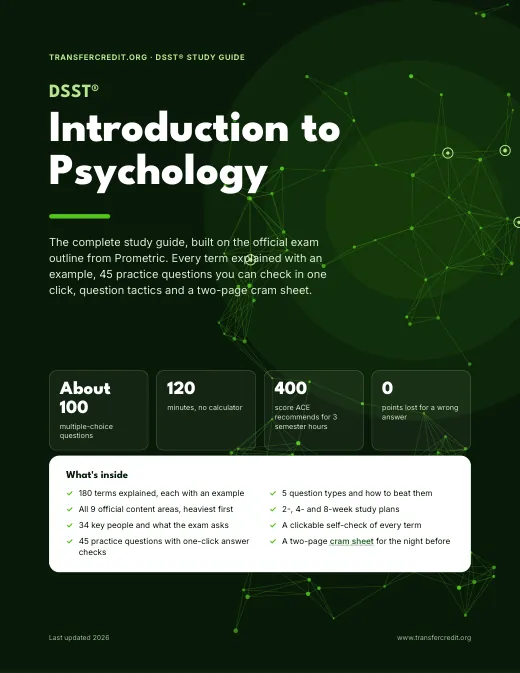
Page 1 of the DSST Introduction to Psychology Study Guide: the cover
Page 1 The cover
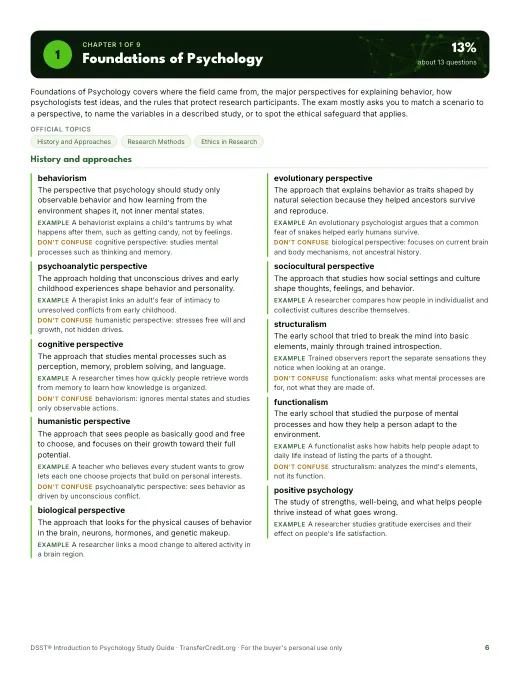
Page 6 of the DSST Introduction to Psychology Study Guide: the Chapter 1 opener
Page 6 The Chapter 1 opener
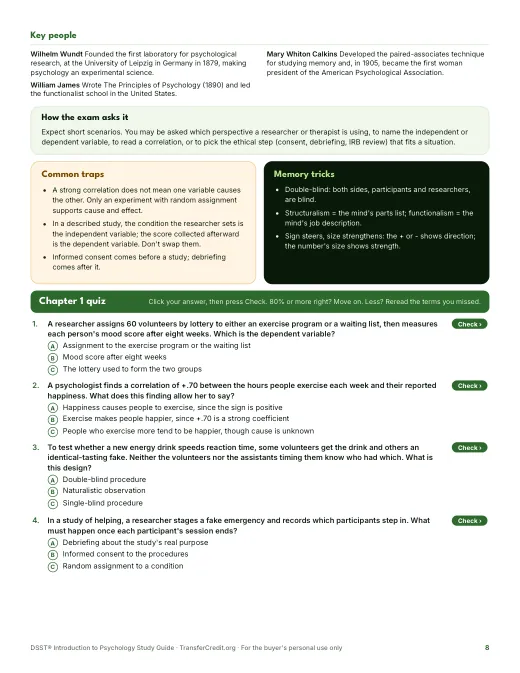
Page 8 of the DSST Introduction to Psychology Study Guide: a chapter quiz
Page 8 A chapter quiz
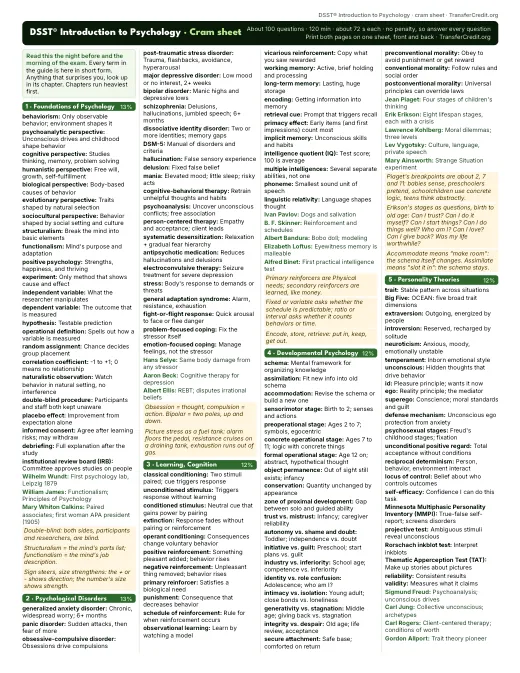
Page 38 of the DSST Introduction to Psychology Study Guide: the 2-page cram sheet
Page 38 The 2-page cram sheet

What you get for $5

One chapter for each official content area, in the order the exam weighs them.

  • 📘39pages, printable
  • 🧭9chapters, heaviest first
  • 🔑180terms with examples
  • ✍️45practice questions, answers explained
  • ⚠️27exam traps to avoid
  • 📄2page cram sheet

Try 10 free Introduction to Psychology questions

In the style of the real exam, from all 9 areas. About 10 minutes, with every answer explained and a score by area.

10 questions  
  1. Question 1 · Foundations of Psychology

    A researcher assigns 60 volunteers by lottery to either an exercise program or a waiting list, then measures each person's mood score after eight weeks. Which is the dependent variable?

    Show the answer

    Answer: C. Mood score after eight weeks. The dependent variable is what is measured as the outcome. Mood score is measured to see if it changes with exercise.

    The trap: Assignment to exercise or waiting list is tempting, but it is the independent variable because the researcher sets it.

  2. Question 2 · Psychological Disorders, Treatment and Health

    For eight months, a woman has worried almost daily about her job, finances and her children's safety. She feels restless and tense, but has never had a sudden attack of intense fear. Which diagnosis fits best?

    Show the answer

    Answer: B. Generalized anxiety disorder. Persistent, hard-to-control worry about many topics for over six months, without panic attacks, is generalized anxiety disorder.

    The trap: Panic disorder is wrong because it requires recurrent sudden panic attacks, which she has not had.

  3. Question 3 · Learning, Cognition and Memory

    Each time a nurse's pager beeps, she rushes to a frightening emergency. After weeks of this, the beep alone makes her heart pound. In this example, what is the beep?

    Show the answer

    Answer: A. Conditioned stimulus. The beep was neutral at first. After being paired with emergencies, it now sets off a pounding heart on its own, so it is a conditioned stimulus.

    The trap: Unconditioned stimulus is tempting because the beep now triggers the reaction, but the unconditioned stimulus is the emergency, which caused fear without learning.

  4. Question 4 · Developmental Psychology

    A 14-month-old learns about a new toy by banging it on the floor, putting it in her mouth and shaking it. According to Piaget, she is in which stage?

    Show the answer

    Answer: C. Sensorimotor stage. Infants and toddlers up to about age 2 learn through senses and physical actions, which is the sensorimotor stage.

    The trap: Concrete operational stage is tempting because she handles a real object, but that stage involves logical thinking about objects, which begins around age 7.

  5. Question 5 · Personality Theories

    Hungry during a long meeting, a man is tempted to grab a snack from a colleague's bag. Knowing that would cause trouble, he waits for the break and buys his own. In Freud's theory, which part of personality chose the realistic course?

    Show the answer

    Answer: B. Ego. The ego mediates between the urge, moral rules, and reality to choose a workable action.

    The trap: Superego is tempting because he is restraining himself, but the superego supplies moral rules and guilt, while the ego weighs reality and chooses.

  6. Question 6 · Social Psychology

    A man who believes honesty is important cheats on his taxes. Afterward he tells himself that "everyone does it" and that the government wastes the money anyway. His reasoning mainly serves to reduce

    Show the answer

    Answer: A. cognitive dissonance. His behavior conflicts with his belief in honesty. He changes how he interprets the behavior to relieve the resulting discomfort, which is cognitive dissonance reduction.

    The trap: The fundamental attribution error is wrong because it is about judging other people's behavior; he is easing the clash between his own belief and action.

  7. Question 7 · Biological Bases

    After a car accident damaged the front of his brain, a previously careful accountant begins making impulsive financial choices and cannot follow multi-step plans. Which region was most likely injured?

    Show the answer

    Answer: B. Frontal lobe. The frontal lobe handles planning, judgment and impulse control, so damage there produces exactly these changes.

    The trap: Cerebellum is wrong because it coordinates balance and smooth movement; it does not plan or control impulses.

  8. Question 8 · Sensation and Perception

    In a hearing test, a patient says she hears a tone about half of the time when it is played at 20 decibels, and almost never when it is quieter. What has been measured?

    Show the answer

    Answer: C. Her absolute threshold. The absolute threshold is the faintest stimulus a person detects half of the time, which matches the 20-decibel tone.

    The trap: Difference threshold is tempting because it is also a threshold, but it measures the smallest noticeable change between two stimuli.

  9. Question 9 · Motivation and Emotion

    During a power outage, a man hears glass shatter downstairs. He notices his hands shaking and his heart pounding, and only then thinks, "I'm terrified." Which theory best matches this order of events?

    Show the answer

    Answer: A. James-Lange theory. He becomes aware of his bodily reactions first and the emotion follows from them, as the James-Lange theory describes.

    The trap: Cannon-Bard theory is tempting because it also involves arousal, but it says the bodily reaction and the feeling happen at the same time.

  10. Question 10 · Foundations of Psychology

    A psychologist finds a correlation of +.70 between the hours people exercise each week and their reported happiness. What does this finding allow her to say?

    Show the answer

    Answer: A. People who exercise more tend to be happier, though cause is unknown. A correlation shows that two variables move together. Without an experiment, neither direction of cause can be claimed.

    The trap: Exercise makes people happier is tempting because +.70 is strong, but strength shows how closely the variables move together, not cause.

The DSST Introduction to Psychology exam at a glance

The DSST Introduction to Psychology exam is a 120-minute, computer-based test from Prometric with about 100 multiple-choice questions. A score of 400 on the 200–500 scale earns an ACE credit recommendation of 3 semester hours, though each college sets its own policy. The exam covers 9 content areas; the heaviest is Foundations of Psychology at 13%.

Questions
About 100multiple choice
Time
120 minabout 72 seconds a question
Passing score
400on a 200–500 scale
ACE credit
3semester hours
Exam fee
$100paid to Prometric
Calculator
Nonot allowed

Source: official DSST Introduction to Psychology exam page.

What the exam covers

9 areas, heaviest first. The guide's chapters follow this order.

  1. Foundations of Psychology13%
  2. Psychological Disorders, Treatment and Health13%
  3. Learning, Cognition and Memory12%
  4. Developmental Psychology12%
  5. Personality Theories12%
  6. Social Psychology11%
  7. Biological Bases9%
  8. Sensation and Perception9%
  9. Motivation and Emotion9%

How it works

  1. 1Buy once, $5Secure checkout. No subscription needed.
  2. 2Download the PDFFrom your TransferCredit.org account, right away and any time later.
  3. 3Study the heaviest areas firstFollow the 2-, 4- or 8-week plan, then read the cram sheet the night before.

Questions students ask

What's in the full DSST Introduction to Psychology study guide?
39 pages: 9 chapters, one per official content area, heaviest first. 180 terms, each with a plain-English definition and an example, 34 key people, common traps and memory tricks, 45 practice questions with an answer key that explains every answer, question tactics, 2-, 4- and 8-week study plans and a 2-page cram sheet.
How much is the full DSST Introduction to Psychology study guide?
The full 39-page PDF is $5, a one-time payment. The 10 practice questions on this page are free, with no account.
What does the $29 plan include?
$29 a month gives you all DSST subjects: every DSST study guide plus the full prep course for each subject, and you can cancel anytime. If you only need this exam, the guide on its own is a one-time $5.
How do I get the full guide?
Choose Buy this guide ($5) and check out. Then sign in to your TransferCredit.org account, then open the course and its Download Your Study Guide lesson. The PDF is yours to keep, and you can download it again from your account at any time.
Can I print the guide or use it on my phone?
Yes. It's a PDF, so it opens on phones, tablets and computers, and printing is allowed. Its tick boxes and answer bubbles work in PDF readers that support forms. Copying and editing are turned off.
Is this an official DSST study guide?
No. DSST® is a registered trademark of Prometric, which was not involved in producing this guide and does not endorse it. TransferCredit.org is independent. We built the guide from the official exam outline, and the exam details were checked against Prometric's published exam information in 2026.
Why is this study guide better than a generic review?
It follows the official outline area by area and spends the most pages on what the exam weighs most. Every term comes with an example, each chapter names the traps the exam sets, and the answer key explains why the most tempting wrong answer is wrong, not just which answer is right. It ends with a 2-page cram sheet for the night before.
What is the DSST Introduction to Psychology exam?
The DSST Introduction to Psychology exam is a 120-minute, computer-based test from Prometric with about 100 multiple-choice questions. A score of 400 on the 200–500 scale earns an ACE credit recommendation of 3 semester hours, though each college sets its own policy. The exam covers 9 content areas; the heaviest is Foundations of Psychology at 13%.
More questions about the DSST Introduction to Psychology exam (21)
How many questions are on the DSST Introduction to Psychology exam, and how long is it?
It has 100 questions to be answered in 2 hours.
What is the passing score for DSST Introduction to Psychology?
The passing score is 400 on a 200–500 scale. At 400 or above, the American Council on Education (ACE) recommends 3 semester hours. Each college sets its own passing score and credit award, so check your school's policy before you book.
How much does the DSST Introduction to Psychology exam cost?
The exam fee is $100, paid to Prometric. Test centers may add their own administration fee. Eligible U.S. military service members can usually test for free through DANTES.
How many college credits is DSST Introduction to Psychology worth?
ACE recommends 3 semester hours for a passing score of 400. Your college decides how many credits it awards and which course they replace. Check your college's policy.
Is there a penalty for guessing on DSST Introduction to Psychology?
No. Your score counts only correct answers, so a wrong answer costs nothing. Never leave a question blank: rule out what you can and pick your best guess.
What topics are on the DSST Introduction to Psychology exam?
9 content areas, from the official outline: Foundations of Psychology (13%); Psychological Disorders, Treatment and Health (13%); Learning, Cognition and Memory (12%); Developmental Psychology (12%); Personality Theories (12%); Social Psychology (11%); Biological Bases (9%); Sensation and Perception (9%); Motivation and Emotion (9%).
Which DSST Introduction to Psychology topics should I study first?
Start with the three heaviest: Foundations of Psychology (13%), Psychological Disorders, Treatment and Health (13%) and Learning, Cognition and Memory (12%). Together they are about 38% of the exam, roughly 38 of 100 questions. The guide's chapters run in that order, heaviest first.
Is the DSST Introduction to Psychology exam hard?
It depends on what you already know. No single area dominates: the largest, Foundations of Psychology, is 13% and the smallest, Motivation and Emotion, is 9%, so broad coverage matters more than deep expertise in one topic. Take the free diagnostic above to see where you stand in about 10 minutes.
What kinds of questions are on the DSST Introduction to Psychology exam?
The guide sorts them into 5 types: “Name the process in a scenario”, “Which term fits this description”, “Match the stage or theory”, “Which BEST describes this judgment” and “Read the research design”. Every question has 3 answer choices. Try the 10 free questions above to see the style.
How long should I study for DSST Introduction to Psychology?
Use the diagnostic to decide. If you already know most areas, two weeks of daily review is often enough; if the subject is new to you, plan on eight. The full guide has 2-, 4- and 8-week plans built from the exam weights.
How should I pace myself on the DSST Introduction to Psychology exam?
On average you have about 72 seconds per question (120 minutes for 100 questions). Be past question 33 a third of the way through and past question 67 two-thirds through. If a question takes more than a minute, pick your best guess, mark it and come back.
What happens if I don't pass DSST Introduction to Psychology?
You can retake a DSST exam after 30 days. Use the wait to work through the areas the score report and the diagnostic show you missed.
Do colleges accept DSST Introduction to Psychology for credit?
DSST exams are accepted at more than 1,500 colleges and universities, but each school decides which exams it accepts, the score it requires and the credit it gives. Look up your college's DSST policy before you book.
Should I take DSST Introduction to Psychology or CLEP Introductory Psychology?
Both cover the same subject. DSST Introduction to Psychology: about 100 questions, 120 minutes, passing score 400, fee $100. CLEP Introductory Psychology: about 95 questions, 90 minutes, passing score 50, fee $97. Take the one your college accepts; most colleges award the credit once, not for both. See the CLEP Introductory Psychology study guide.
How up to date is this DSST Introduction to Psychology guide?
Last updated 2026. The exam details were checked against Prometric's published exam information in 2026. Exams change, so confirm the details on the official exam page before you register.
What should I do the night before the exam?
Read the cram sheet once, slowly. Check your test time, the location or remote-proctoring setup, and the ID you need. Then sleep: a rested brain recalls more than a crammed one. In the morning, skim the memory tricks and common traps, then stop studying.
Can I take DSST Introduction to Psychology online?
Yes. DSST exams can be taken at a test center or online with a remote Prometric proctor.
How many answer choices do DSST Introduction to Psychology questions have?
Three: one correct answer and two incorrect options. With fewer distractors to eliminate, the exam rewards reading each question carefully and knowing the terms precisely.
Which psychologists should I know for DSST Introduction to Psychology?
Know the names tied to each major theory: Pavlov and Skinner for conditioning, Bandura for observational learning, Piaget for cognitive development, Erikson for psychosocial stages, Kohlberg for moral development, Freud for psychodynamic theory, Maslow and Rogers for humanistic psychology, and Milgram and Asch for obedience and conformity. Expect to apply these theories to described situations, not just match names.
Which developmental theories are on DSST Introduction to Psychology?
Developmental Psychology is 12% of the exam, and the outline names three topics: cognitive development stages, psychosocial stages and moral development. In practice that means Piaget's stages, Erikson's psychosocial crises and Kohlberg's levels of moral reasoning.
Is there statistics on the DSST Introduction to Psychology exam?
There's no separate statistics area. Research methods and research ethics sit inside Foundations of Psychology (13%), so know how experimental, correlational and clinical studies differ and what makes a study ethical.

Choose how you want to study

Start with the guide, or get everything for DSST in one plan.

This study guide
$5one-time
  • 39-page printable PDF
  • 180 terms with examples
  • 45 practice questions, answers explained
  • 2-page cram sheet and study plans
Get the guide · $5
Best value Get it all
$29/month
  • Every DSST study guide
  • Prep courses for all DSST subjects
  • Cancel anytime
Get it all · $29/mo

DSST® is a registered trademark of Prometric, which was not involved in producing this guide and does not endorse it. TransferCredit.org is independent and not affiliated with Prometric. © 2026 UPI Globale Edu Inc.