
$5one-time
- 35-page printable PDF
- 181 terms with examples
- 41 practice questions, answers explained
- 2-page cram sheet and study plans
Everything the DSST Organizational Behavior exam tests, in one PDF you can print. Built from Prometric's official outline, heaviest topics first.
Last updated 2026 · exam details checked against Prometric's published exam information in 2026
Real pages from the 35-page PDF.
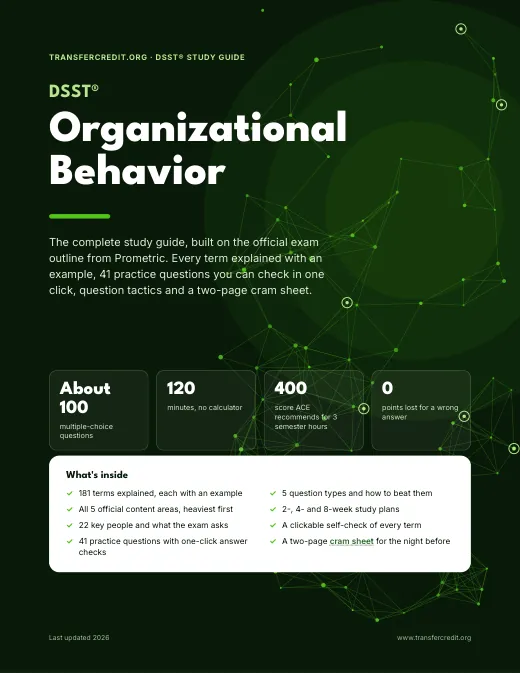
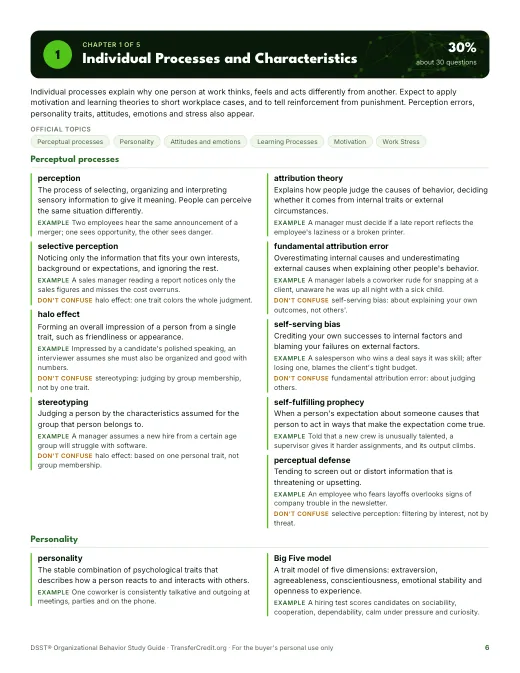
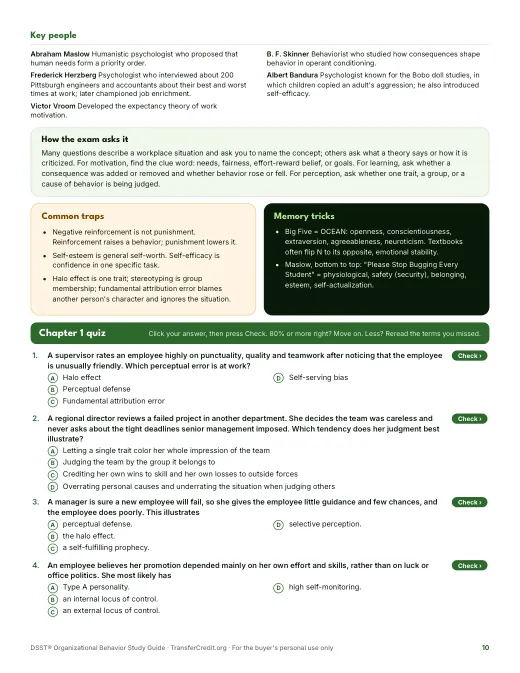
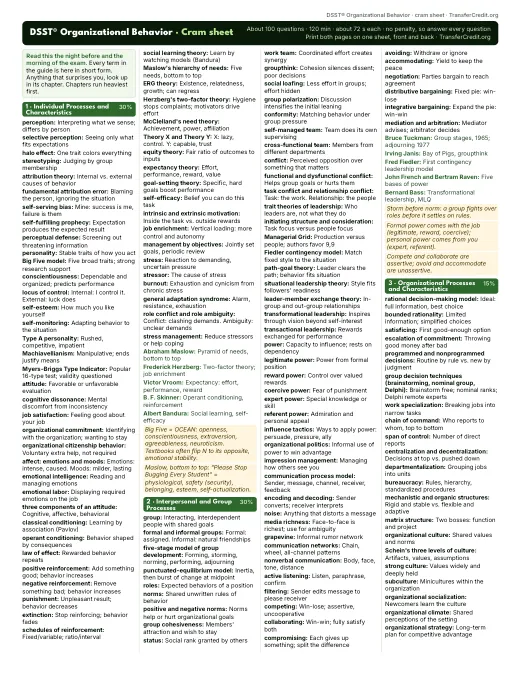
One chapter for each official content area, in the order the exam weighs them.
In the style of the real exam, from all 5 areas. About 10 minutes, with every answer explained and a score by area.
A supervisor rates an employee highly on punctuality, quality and teamwork after noticing that the employee is unusually friendly. Which perceptual error is at work?
Answer: D. Halo effect. A single positive trait (friendliness) colored the ratings on unrelated dimensions, which is the halo effect.
The trap: Fundamental attribution error is about blaming internal causes for others' behavior; here one trait inflates unrelated ratings.
A single positive trait (friendliness) colored the ratings on unrelated dimensions, which is the halo effect.
The trap: Fundamental attribution error is about blaming internal causes for others' behavior; here one trait inflates unrelated ratings.
Members of a newly formed project team openly argue about who should take which assignment and resist the team leader's direction. According to Tuckman's model, which stage are they in?
Answer: B. Storming. Open conflict over roles and resistance to the leader mark the storming stage, which comes after the polite, uncertain forming stage.
The trap: Forming is tempting because the team is new, but members in that stage are polite and unsure; open argument signals storming.
Open conflict over roles and resistance to the leader mark the storming stage, which comes after the polite, uncertain forming stage.
The trap: Forming is tempting because the team is new, but members in that stage are polite and unsure; open argument signals storming.
A hospital administrator gets pressure to cancel a failing computer project but replies, 'We have spent too much already to quit now.' She is showing
Answer: A. escalation of commitment.. She keeps backing a failing course because of past investment, which is escalation of commitment.
The trap: Bounded rationality is tempting, but it concerns limits on information, while her reasoning rests on money already spent.
She keeps backing a failing course because of past investment, which is escalation of commitment.
The trap: Bounded rationality is tempting, but it concerns limits on information, while her reasoning rests on money already spent.
A team leader sketches the pressures favoring a move to remote work, such as lower office costs and employee requests, beside those opposing it, such as security worries and distrust from managers. Which tool is the leader using?
Answer: C. Force-field analysis. Listing the forces pushing for change and the forces pushing against it is force-field analysis, and change comes from strengthening or weakening those forces.
The trap: Survey feedback is wrong because it collects attitude data by questionnaire and shares it back; the leader here is only mapping opposing forces.
Listing the forces pushing for change and the forces pushing against it is force-field analysis, and change comes from strengthening or weakening those forces.
The trap: Survey feedback is wrong because it collects attitude data by questionnaire and shares it back; the leader here is only mapping opposing forces.
A survey finds that employees who exercise more also report higher job satisfaction, and a manager concludes that building a company gym will raise satisfaction. What is the main flaw in that reasoning?
Answer: D. Correlation does not prove exercise causes satisfaction.. Two variables that move together may be linked by a third factor or in the other direction. Only an experiment that manipulates exercise could test cause.
The trap: Switching to interviews would not fix the flaw: any method that only measures the two variables still shows a correlation, not cause.
Two variables that move together may be linked by a third factor or in the other direction. Only an experiment that manipulates exercise could test cause.
The trap: Switching to interviews would not fix the flaw: any method that only measures the two variables still shows a correlation, not cause.
A regional director reviews a failed project in another department. She decides the team was careless and never asks about the tight deadlines senior management imposed. Which tendency does her judgment best illustrate?
Answer: C. Overrating personal causes and underrating the situation when judging others. She blames the team's character and ignores a situational cause, the deadlines, when judging other people's behavior. That is the fundamental attribution error.
The trap: Crediting her own wins and blaming outside forces for her losses is the self-serving bias, but this project was not hers; she is judging other people.
She blames the team's character and ignores a situational cause, the deadlines, when judging other people's behavior. That is the fundamental attribution error.
The trap: Crediting her own wins and blaming outside forces for her losses is the self-serving bias, but this project was not hers; she is judging other people.
In a five-person class presentation, one student prepares very little because the final grade is shared and her work will not be noticed. Which change would best reduce this behavior?
Answer: A. Grade each member's individual contribution as well as the group's. Social loafing falls when individual effort can be identified and rewarded. Making contributions visible removes the hiding place.
The trap: Making the group larger is wrong because larger groups make individual effort easier to hide and increase loafing.
Social loafing falls when individual effort can be identified and rewarded. Making contributions visible removes the hiding place.
The trap: Making the group larger is wrong because larger groups make individual effort easier to hide and increase loafing.
A hiring manager has twenty applicants and offers the job to the first one who meets all requirements, without interviewing the rest. This is
Answer: B. satisficing.. She chose the first acceptable option rather than searching for the best, which is satisficing.
The trap: The rational model would evaluate all candidates against criteria and choose the best, which she did not do.
She chose the first acceptable option rather than searching for the best, which is satisficing.
The trap: The rational model would evaluate all candidates against criteria and choose the best, which she did not do.
After training employees in a new process, a company rewrites its policies and ties pay to using the process so that people do not slip back to old methods. Which step of Lewin's model do the policy and pay changes represent?
Answer: C. Refreezing. Reinforcing the new behavior with policies and rewards so it lasts is refreezing.
The trap: Moving is tempting because the training was part of it, but the later step of making the new behavior permanent is refreezing.
Reinforcing the new behavior with policies and rewards so it lasts is refreezing.
The trap: Moving is tempting because the training was part of it, but the later step of making the new behavior permanent is refreezing.
Output at a plant rose after managers brightened the lighting, and rose again when they dimmed it back. Which explanation best fits this result?
Answer: B. Workers responded to the attention they were getting.. Output rose under opposite changes, so the lighting itself was not the cause. This is the Hawthorne finding: attention and social factors affect behavior.
The trap: The idea that each change in light directly raised output fails because output rose when the light got brighter and when it got dimmer.
Output rose under opposite changes, so the lighting itself was not the cause. This is the Hawthorne finding: attention and social factors affect behavior.
The trap: The idea that each change in light directly raised output fails because output rose when the light got brighter and when it got dimmer.
The DSST Organizational Behavior exam is a 120-minute, computer-based test from Prometric with about 100 multiple-choice questions. A score of 400 on the 200–500 scale earns an ACE credit recommendation of 3 semester hours, though each college sets its own policy. The exam covers 5 content areas; the heaviest is Individual Processes and Characteristics at 30%.
5 areas, heaviest first. The guide's chapters follow this order.
Start with the guide, or get everything for DSST in one plan.
DSST® is a registered trademark of Prometric, which was not involved in producing this guide and does not endorse it. TransferCredit.org is independent and not affiliated with Prometric. © 2026 UPI Globale Edu Inc.